
News
Africa Science Diplomacy Conference: Charting a Collaborative Future for Africa and the World
DSTI
19 November 2026
5 min read
Back to all news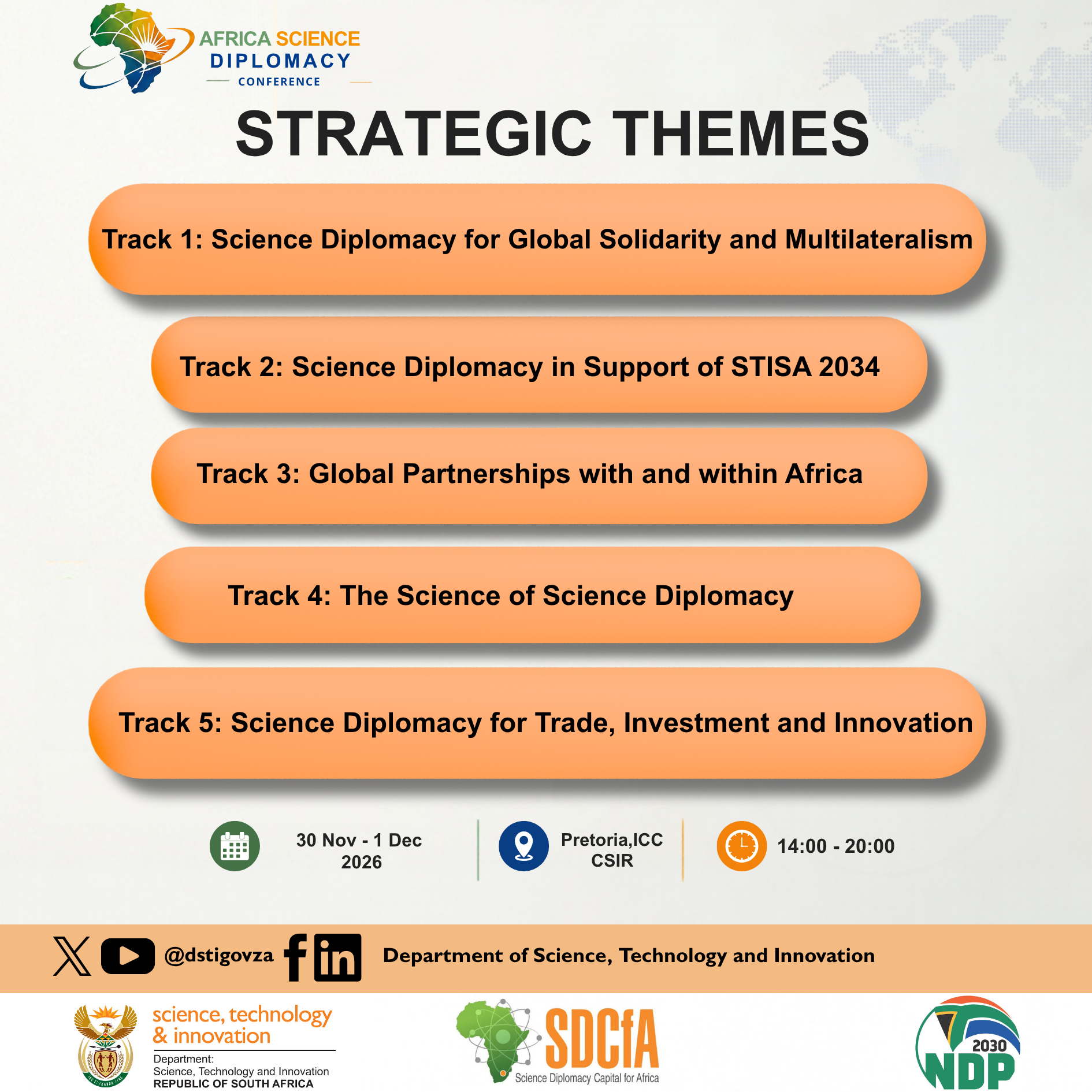
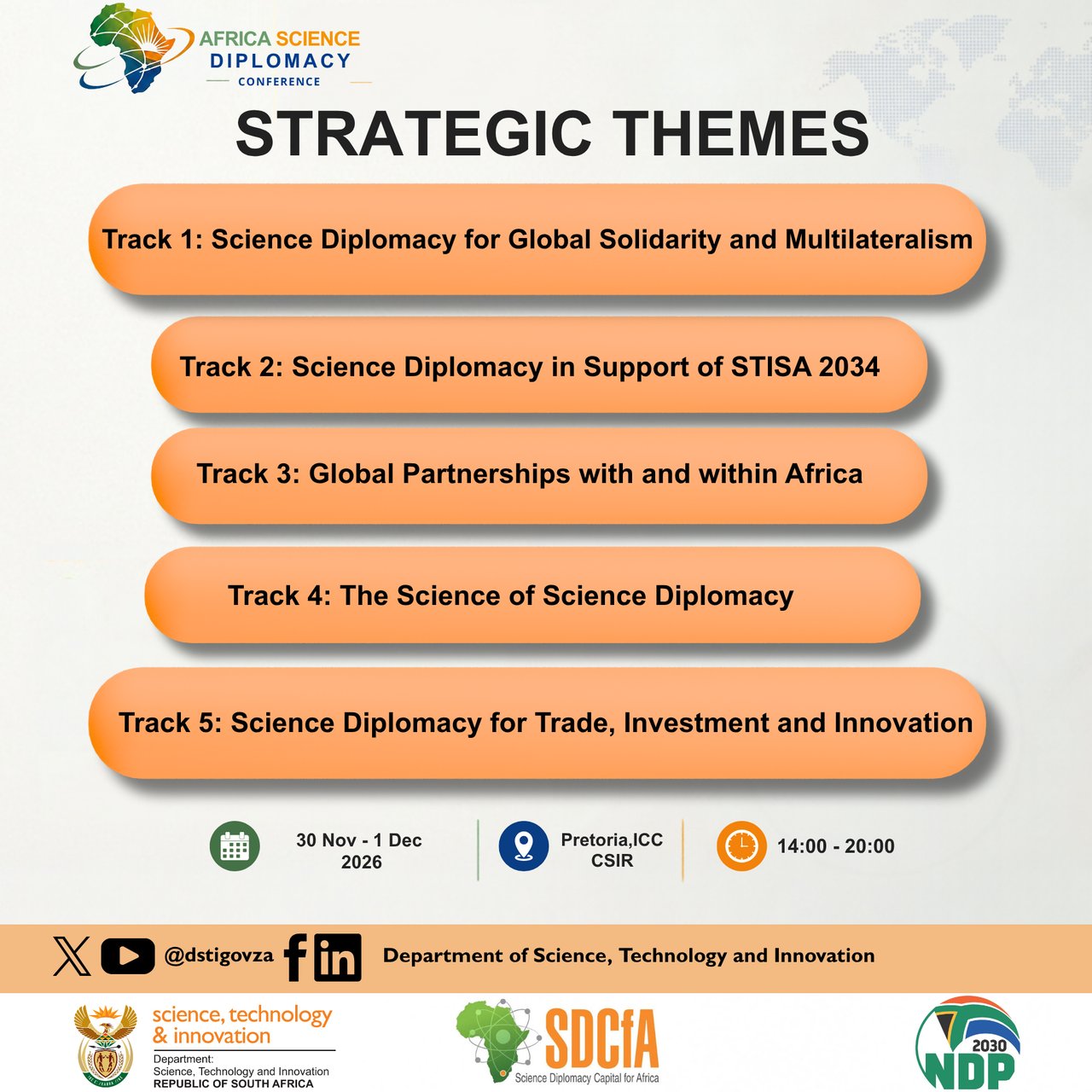
The first conference track, Science Diplomacy for Global Solidarity and Multilateralism, will focus on the role of science as a powerful instrument for international cooperation. As nations face shared challenges that transcend borders, science diplomacy offers opportunities to foster dialogue, trust and collective action.
Discussions will showcase African leadership and success stories in science diplomacy while examining how multilateral cooperation can be strengthened through scientific collaboration. Topics such as climate change, biodiversity conservation, global health security, food systems, water management and sustainable industrialisation will feature prominently.
This track recognises that science is increasingly becoming a bridge between countries, enabling cooperation even in complex geopolitical environments. By strengthening scientific partnerships, nations can work together to address challenges that no country can solve alone.
The conference's second track, Science Diplomacy in Support of STISA 2034, will examine how international cooperation can accelerate the implementation of Africa's Science, Technology and Innovation Strategy for Africa (STISA 2034).
As Africa seeks to build knowledge-based economies and strengthen scientific capabilities, science diplomacy can play a crucial role in mobilising expertise, resources and partnerships. Discussions will explore how countries can improve policy coherence, build institutional capacity and align science and innovation initiatives with the broader goals of Agenda 2063 and the Sustainable Development Goals (SDGs).
Participants will also examine how regional and continental collaboration can help address common development priorities while strengthening Africa's collective scientific and technological capabilities.
A key focus of the conference will be the importance of developing balanced and mutually beneficial scientific partnerships. The third track, Global Partnerships with and within Africa, will explore how science diplomacy can support equitable collaboration among nations and institutions.
Discussions will examine various partnership models, including South-South cooperation, North-South partnerships and triangular collaboration mechanisms. Participants will consider how Africa can strengthen access to emerging technologies, promote knowledge co-creation and ensure that international scientific cooperation delivers benefits for all partners.
The track will also explore Africa's role within multilateral forums and global governance institutions, highlighting the importance of ethical and inclusive approaches to international scientific collaboration.
As science diplomacy continues to gain prominence globally, there is growing interest in understanding how it works, what impact it delivers and how it can be measured effectively. This forms the focus of the fourth track, The Science of Science Diplomacy.
The discussions will examine concepts, definitions and frameworks that underpin science diplomacy, while also exploring education and training programmes designed to build the next generation of science diplomats.
Particular attention will be given to monitoring and evaluation methodologies, indicators for measuring impact and comparative studies that identify best practices from around the world. Importantly, the track seeks to deepen understanding of science diplomacy from an African perspective, helping to develop approaches that reflect the continent's unique priorities and realities.
The fifth conference track, Science Diplomacy for Trade, Investment and Innovation, will highlight the economic dimensions of science diplomacy and its potential to support industrial development and innovation-led growth.
As countries seek to compete in an increasingly knowledge-driven global economy, science diplomacy can facilitate technology transfer, attract investment and strengthen international innovation partnerships. Discussions will focus on innovation ecosystems, commercialisation pathways, research funding mechanisms and public-private partnerships that support technological advancement.
The track will also explore the role of science diplomacy in advancing the objectives of the African Continental Free Trade Area (AfCFTA) and promoting sustainable industrialisation across the continent. Participants will examine how international scientific collaboration can unlock new opportunities for economic diversification, job creation and competitiveness.
While each conference track addresses specific aspects of science diplomacy, several cross-cutting themes will feature throughout the programme.
These include:
• Africa's growing contribution to global science diplomacy.
• Strengthening international cooperation and multilateralism.
• Harnessing innovation and emerging technologies.
• Building science diplomacy capacity across institutions and countries.
• Exploring future directions for science diplomacy.
• Supporting sustainable development through science and innovation.
• Promoting inclusive and equitable international partnerships.
Together, these themes reflect a growing recognition that science diplomacy is no longer a niche field but an essential component of international engagement in the 21st century.
The Africa Science Diplomacy Conference comes at a critical moment when countries are seeking new ways to navigate global uncertainty while accelerating progress towards sustainable development. By bringing together diverse stakeholders from across Africa and the international community, the conference aims to strengthen dialogue, foster partnerships and generate actionable ideas that can advance both continental and global priorities.
More importantly, the conference offers an opportunity to showcase Africa's growing leadership in science diplomacy and to demonstrate how the continent can contribute to shaping a more collaborative, innovative and sustainable future. As science increasingly influences economic development, international relations and global governance, Africa's voice and expertise will be essential in ensuring that science diplomacy serves the interests of all nations and peoples.
The conference is therefore expected to be more than a gathering of experts. It will be a platform for building the partnerships, policies and evidence needed to harness science as a force for cooperation, development and shared prosperity. It will conclude on 1 December, with the presentation of a Science Diplomacy Manifesto for Africa.
As the world confronts increasingly complex challenges ranging from climate change and pandemics to food insecurity and technological disruption, science diplomacy is emerging as a critical tool for building international cooperation and finding sustainable solutions. Against this backdrop, the upcoming Africa Science Diplomacy Conference will bring together policymakers, scientists, diplomats, industry leaders and development partners to explore how science can strengthen international relations and advance Africa's development aspirations.
Taking place from 30 November to 1 December 2026, the Department of Science, Technology and Innovation (DSTI) through the Science Diplomacy Capital for Africa (SDCfA) platform is hosting the conference. The first of its gathering provides a strategic platform to examine the growing role of science diplomacy in addressing global challenges, promoting equitable partnerships and leveraging science, technology and innovation (STI) to advance sustainable development. Through five thematic tracks and a series of cross-cutting discussions, participants will explore how Africa can position itself as both a contributor to and beneficiary of the global science diplomacy agenda.The first conference track, Science Diplomacy for Global Solidarity and Multilateralism, will focus on the role of science as a powerful instrument for international cooperation. As nations face shared challenges that transcend borders, science diplomacy offers opportunities to foster dialogue, trust and collective action.
Discussions will showcase African leadership and success stories in science diplomacy while examining how multilateral cooperation can be strengthened through scientific collaboration. Topics such as climate change, biodiversity conservation, global health security, food systems, water management and sustainable industrialisation will feature prominently.
This track recognises that science is increasingly becoming a bridge between countries, enabling cooperation even in complex geopolitical environments. By strengthening scientific partnerships, nations can work together to address challenges that no country can solve alone.
The conference's second track, Science Diplomacy in Support of STISA 2034, will examine how international cooperation can accelerate the implementation of Africa's Science, Technology and Innovation Strategy for Africa (STISA 2034).
As Africa seeks to build knowledge-based economies and strengthen scientific capabilities, science diplomacy can play a crucial role in mobilising expertise, resources and partnerships. Discussions will explore how countries can improve policy coherence, build institutional capacity and align science and innovation initiatives with the broader goals of Agenda 2063 and the Sustainable Development Goals (SDGs).
Participants will also examine how regional and continental collaboration can help address common development priorities while strengthening Africa's collective scientific and technological capabilities.
A key focus of the conference will be the importance of developing balanced and mutually beneficial scientific partnerships. The third track, Global Partnerships with and within Africa, will explore how science diplomacy can support equitable collaboration among nations and institutions.
Discussions will examine various partnership models, including South-South cooperation, North-South partnerships and triangular collaboration mechanisms. Participants will consider how Africa can strengthen access to emerging technologies, promote knowledge co-creation and ensure that international scientific cooperation delivers benefits for all partners.
The track will also explore Africa's role within multilateral forums and global governance institutions, highlighting the importance of ethical and inclusive approaches to international scientific collaboration.
As science diplomacy continues to gain prominence globally, there is growing interest in understanding how it works, what impact it delivers and how it can be measured effectively. This forms the focus of the fourth track, The Science of Science Diplomacy.
The discussions will examine concepts, definitions and frameworks that underpin science diplomacy, while also exploring education and training programmes designed to build the next generation of science diplomats.
Particular attention will be given to monitoring and evaluation methodologies, indicators for measuring impact and comparative studies that identify best practices from around the world. Importantly, the track seeks to deepen understanding of science diplomacy from an African perspective, helping to develop approaches that reflect the continent's unique priorities and realities.
The fifth conference track, Science Diplomacy for Trade, Investment and Innovation, will highlight the economic dimensions of science diplomacy and its potential to support industrial development and innovation-led growth.
As countries seek to compete in an increasingly knowledge-driven global economy, science diplomacy can facilitate technology transfer, attract investment and strengthen international innovation partnerships. Discussions will focus on innovation ecosystems, commercialisation pathways, research funding mechanisms and public-private partnerships that support technological advancement.
The track will also explore the role of science diplomacy in advancing the objectives of the African Continental Free Trade Area (AfCFTA) and promoting sustainable industrialisation across the continent. Participants will examine how international scientific collaboration can unlock new opportunities for economic diversification, job creation and competitiveness.
While each conference track addresses specific aspects of science diplomacy, several cross-cutting themes will feature throughout the programme.
These include:
• Africa's growing contribution to global science diplomacy.
• Strengthening international cooperation and multilateralism.
• Harnessing innovation and emerging technologies.
• Building science diplomacy capacity across institutions and countries.
• Exploring future directions for science diplomacy.
• Supporting sustainable development through science and innovation.
• Promoting inclusive and equitable international partnerships.
Together, these themes reflect a growing recognition that science diplomacy is no longer a niche field but an essential component of international engagement in the 21st century.
The Africa Science Diplomacy Conference comes at a critical moment when countries are seeking new ways to navigate global uncertainty while accelerating progress towards sustainable development. By bringing together diverse stakeholders from across Africa and the international community, the conference aims to strengthen dialogue, foster partnerships and generate actionable ideas that can advance both continental and global priorities.
More importantly, the conference offers an opportunity to showcase Africa's growing leadership in science diplomacy and to demonstrate how the continent can contribute to shaping a more collaborative, innovative and sustainable future. As science increasingly influences economic development, international relations and global governance, Africa's voice and expertise will be essential in ensuring that science diplomacy serves the interests of all nations and peoples.
The conference is therefore expected to be more than a gathering of experts. It will be a platform for building the partnerships, policies and evidence needed to harness science as a force for cooperation, development and shared prosperity. It will conclude on 1 December, with the presentation of a Science Diplomacy Manifesto for Africa.
See the full conference programme. https://www.asdc.co.za/programme/#toggle-id-39