

Hluma centre to drive indigenous agri-innovation, entrepreneurship and commercialisation
On 22 May 2026, the Department of Science, Technology and Innovation (DSTI) and the University of KwaZulu-Natal (UKZN) launched the Hluma Centre for Entrepreneurship and Rapid Incubator at UKZN's Howard Campus in Durban.
The centre is a pioneering initiative focused on accelerating enterprise development and commercialising innovations in agro-processing, indigenous crops and traditional medicine value chains. Through a structured incubation programme, the centre will provide entrepreneurs with technical expertise, mentorship, innovation support, market access and business development opportunities.
The initiative places the DSTI at the forefront of enabling science-led entrepreneurship rooted in indigenous knowledge systems and inclusive economic development. Strategic partners in the initiative include the Technology Innovation Agency (TIA), the Small Enterprise Development and Finance Agency (SEDFA), the Council for Scientific and Industrial Research, the Agricultural Research Council, the United Kingdom's Foreign, Commonwealth and Development Office, and India's Biotechnology Industry Research Assistance Council.
Speaking at the launch, Prof. Fhatuwani Mudau, Deputy Vice-Chancellor and Head of the College of Agriculture, Engineering and Science at UKZN, said that the centre "[brought] together research, innovation and indigenous knowledge to respond to some of South Africa's most pressing challenges, including unemployment, food security and limited participation in the formal economy."
He spoke of the need for universities to evolve beyond their traditional roles. "As universities, we can no longer function only as centres of teaching and research. We must actively contribute to economic development by strengthening entrepreneurship, supporting innovation systems and ensuring that knowledge generated within institutions translates into practical solutions, businesses, jobs and sustainable markets," he said.
The Hluma Centre is the culmination of years of research on underutilised indigenous crops and climate-resilient food systems led by Prof. Tafadzwa Mabhaudhi, Professor of Climate Change, Food Systems and Health at the London School of Hygiene and Tropical Medicine, and Director of the Lancet Countdown Africa Centre.
Mabhaudhi explained that research focused on identifying indigenous crops with strong nutritional value, climate resilience and commercial potential had been under way for many years.
"We identified priority underutilised crops including madumbe, cassava, millet, sorghum, Bambara groundnuts, spider plants and cowpeas. But we recognised that research alone was not enough. We needed to develop entire value chains – from seed systems and large-scale farming to product development, processing and commercialisation," said Mabhaudhi.
He highlighted the critical role played by the DSTI, TIA and SEDFA in advancing the vision. "They believed in the dream of transforming indigenous crops into commercially viable opportunities that benefit communities across the value chain," he said.
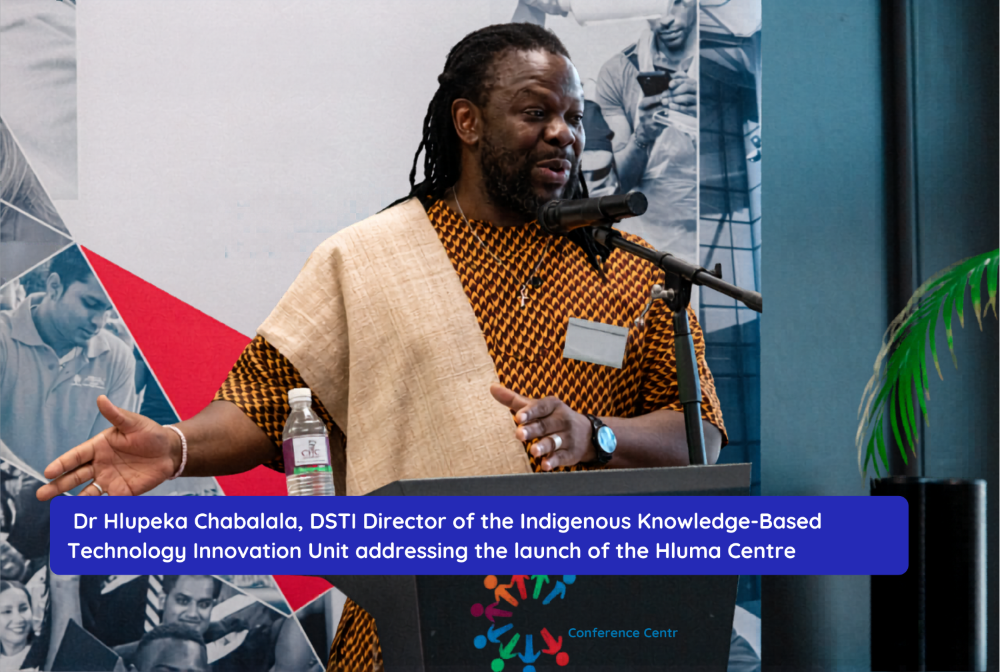
Speaking on behalf of the DSTI, Dr Hlupeka Chabalala, Director of the Indigenous Knowledge-Based Technology Innovation Unit, praised the multidisciplinary approach underpinning Hluma and reaffirmed the Department's commitment to inclusive innovation driven by African knowledge systems.
Chabalala said the DSTI's indigenous knowledge (IK) work was based on the 2004 IK Policy and the 2019 Protection, Promotion, Development and Management of IK Act, and focused on research, development, innovation and commercialisation based on African knowledge systems.
"We support innovation across the value chain, ensuring that indigenous knowledge holders retain ownership of products, intellectual property, manufacturing and supply chains. Our dream is to move beyond small enterprises towards industrialisation, because South Africa has the biodiversity, indigenous knowledge, scientific capability and now the political will to support this vision," he said.
He added that the Hluma model should be replicated nationally. "We need many Hlumas across the country. Every province should have innovation centres that support local communities and unlock indigenous economic potential."
The Hluma incubation programme has already identified 20 businesses to participate in its first cohort. One of them is NJ Projects Pty (Ltd), a growing agricultural enterprise in the Okhahlamba (Bergville) area.
Founded in 2019 and led by entrepreneur Njabulo Sihle Hlatshwayo, the business operates on approximately three hectares of cultivated land, producing crops such as cabbage, green peppers, chillies, potatoes, onions, sugar beans, spinach, tomatoes, brinjal, strawberries and maize.
The enterprise currently has 5 000 cabbages growing, and combines organic and conventional farming approaches, reflecting the kind of scalable, community-rooted agribusinesses the Hluma Centre seeks to support.
The Hluma Centre signals a significant step in building a more inclusive innovation economy that harnesses indigenous knowledge, supports entrepreneurs and creates sustainable livelihoods through science, technology and innovation.
Issued by the Department of Science, Technology and Innovation.
For more information, contact Julian Leshilo-Sebake at This email address is being protected from spambots. You need JavaScript enabled to view it. or 060 961 2194.


