
Intellectual property crucial for enabling sport development through innovation
This week, the country will mark the 25th World Intellectual Property Day (WIPD) 2026. The event serves as a catalyst for a nationwide outreach campaign aimed at raising awareness about the role and significance of intellectual property in everyday life.
Intellectual Property (IP) is an important element of daily life, shaping the technology we use, the products we trust, and even the sports we watch and play. From performance-enhancing sportswear and beverages, smart fitness devices, to broadcasting systems and fan engagement platforms, IP ensures that ideas are protected and rewarded. As the custodian of IP arising from publicly financed research and development under the IPR Act (Act 51 of 2008), the Department of Science, Technology and Innovation (DSTI), through its National Intellectual Property Management Office (NIPMO), plays a central role in harnessing the power of IP to drive innovation, support research, and translate ideas into real-world impact across sectors, including sport.
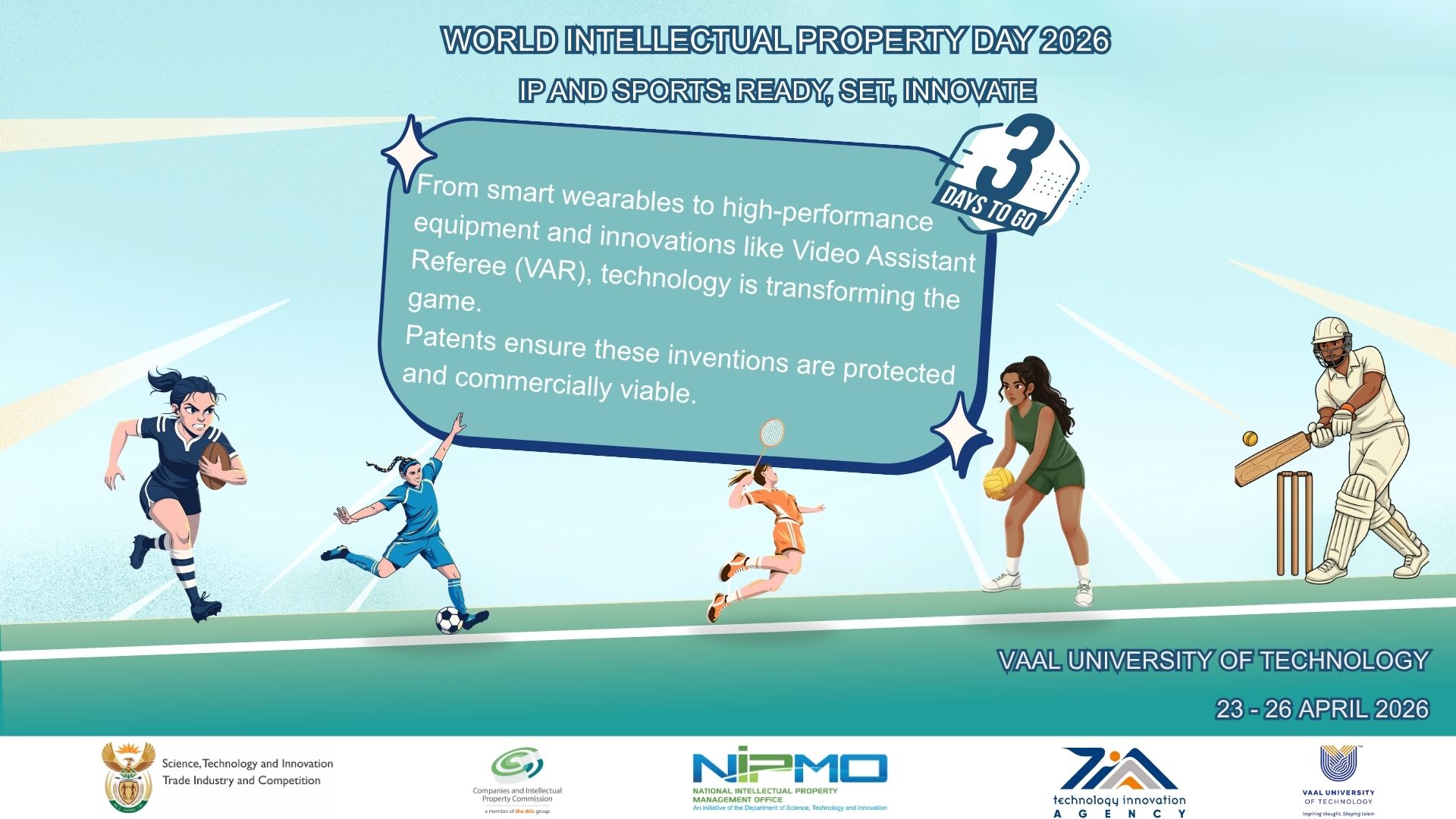
This year’s WIPD will take place under the theme, “IP and Sports: Ready, Set, Innovate!”
Earlier this month, the DSTI participated in a media launch event hosted at the Vaal University of Technology (VUT). The event was organised by the Companies and Intellectual Property Commission (CIPC), in partnership with the Department of Trade, Industry and Competition (the dtic), the DSTI, and its specialised unit, the National Intellectual Property Management Office (NIPMO), as well as its entity, the Technology Innovation Agency (TIA).
Speaking at the launch, CIPC Commissioner Rory Voller emphasised that the celebration highlights the value and strategic importance of IP to the public—a mission that CIPC advances across South Africa through education and awareness programmes.
Reflecting on this year’s theme, Advocate Voller said that technology and innovation in sport enhance training precision, enable real-time performance tracking, and improve officiating through artificial intelligence (AI)-driven systems such as the Video Assistant Referee (VAR) and Hawk-Eye ball-tracking technology. These innovations protect the integrity of the game and reduce the sense of injustice among players and fans.
He added that IP touches every aspect of human life and our ecosystem, noting that its rapid growth among young people can serve as a transformative force in economies and communities.
“One cannot overlook the value of technology in fan engagement. Virtual reality and augmented reality provide enjoyable viewing experiences, bringing the game closer to fans,” he said.
“IP-driven innovations such as high-performance footwear enable athletes to run faster, jump higher, and endure more, while developments in apparel design, including advanced fabrics and structures, help release sweat and improve comfort during play,” Voller added.
The DSTI’s Director: Advisory and Support at NIPMO, Mr Thabang Jase, said that innovation backed by IP rights keeps the world of sport thriving, dynamic, and accessible to all. He noted that, through partnerships, NIPMO will ensure that IP arising from publicly funded research and development is leveraged for national benefit.
VUT Vice-Chancellor and Principal, Professor Khehla Ndlovu, said the launch was not merely about marking a date on the calendar, but about igniting conversations at the heart of progress and the advancement of human creativity.
The annual WIPD, commemorated globally on 26 April, reminds us that behind every innovation and creative expression is a mind that dares to imagine differently.
“This platform exists to deepen awareness, promote respect for intellectual property, and position institutions such as VUT as catalysts for innovation and socio-economic development,” said Professor Ndlovu.
“At first glance, sport is movement, competition, and spectacle. However, beneath the surface lies a powerful ecosystem of innovation—from performance analytics and wearable technology, to equipment design and broadcasting rights. Sport is driven by intellectual capital that is protected, commercialised, and scaled,” he added, noting that the university produces graduates who turn ideas into impact through its Technology Transfer Office (TTO).
The dtic Acting Chief Director: Innovation and Technology, Ms Nontombi Maseko, emphasised that innovation advances sport by enabling inclusivity and transformation, particularly by bringing persons with disabilities into sporting activities. She highlighted that technological innovations in wheelchairs have enabled wheelchair basketball, while advances in prosthetics allow athletes with amputations to run and compete.
The WIPD campaign will showcase a roadshow called IP Talk on 23 and 24 April 2026 at Thabong Mall and the VUT Science and Technology Park in Sebokeng, as part of ongoing education and awareness activities commemorating WIPD.
For enquiries, please contact Ms Julian Leshilo-Sebake on This email address is being protected from spambots. You need JavaScript enabled to view it. or 060 961 2194
Issued by the Department of Science , Technology and Innovation


