
Deputy Minister Gina reflects on 2025 achievements, power of partnerships for national development
As the year draws to a close, the Deputy Minister of Science, Technology and Innovation, Dr Nomalungelo Gina, has reflected on a year of steady progress in advancing science, technology, and innovation as central pillars of South Africa’s economic transformation, inclusive growth, and long-term development.
Throughout 2025, the Deputy Minister’s engagements consistently underscored the importance of innovation-led growth, human capital development and strategic collaboration in strengthening the national innovation system. Her work focused on ensuring that public investment in science and technology translates into tangible economic and social benefits for communities across the country.
Women in Science
One of the highlights of the year was the successful hosting of the 2025 South African Women in Science Awards, which celebrated excellence, resilience, and leadership among women scientists and innovators. The awards reaffirmed the government’s commitment to advancing gender transformation in science and innovation, while inspiring young women and girls to pursue careers in STEM fields that are critical to the country’s future growth and competitiveness.
International Partnerships
International cooperation remained a key pillar of the Deputy Minister’s work in 2025. Through official visits to countries such as China and Japan, Dr Gina strengthened bilateral collaboration in science, technology and innovation, with a focus on research partnerships, skills development, technology exchange and innovation-led industrial development. These engagements reinforced South Africa’s position as a trusted global partner and opened new avenues for collaboration in priority areas of national development.
At multilateral and continental platforms, including the G20 Africa Day Celebration at the University of Mpumalanga and the 17th e-Learning Africa Ministerial Roundtable in Dar es Salaam, the Deputy Minister advanced South Africa’s perspectives on the role of science, digital learning, and innovation in addressing development challenges.
She highlighted the importance of harnessing technology to expand access to education, strengthen skills development, and support inclusive economic participation across Africa.
Technologies of the future
A key area of progress during the year was South Africa’s positioning within emerging global industries. At platforms such as the African Green Hydrogen Summit, Dr. Gina championed green hydrogen as a catalytic sector for industrialisation, investment attraction, and job creation, while emphasising the need to move decisively from research to commercialization and value-chain development.
This future-focused agenda was further reinforced through the unveiling of the Centre for Quantum Computing and Technology at the University of KwaZulu-Natal, strengthening national capability in next-generation technologies.
The Deputy Minister applauded the integration of advanced technologies into education and skills development, including the launch of IRIS, South Africa’s first AI-powered teaching robot, reflecting the Department’s commitment to preparing young people for a rapidly evolving digital economy.
Inclusive innovation remained a defining feature of the Deputy Minister’s work throughout the year. Through continued support for grassroots innovators and advocacy for stronger intellectual property awareness, particularly at the WIPO-SA Summer School on Intellectual Property and Technology Transfer, Dr Gina reinforced the importance of protecting ideas and enabling innovators, especially young researchers, township entrepreneurs, and rural innovators, to convert knowledge into sustainable economic value.
Urging business investment in STI
Partnerships emerged as a central enabler of South Africa’s growth and development agenda. In her address to the Fondation L’Oréal–UNESCO For Women in Science Sub-Saharan Africa Young Talents Programme, the Deputy Minister emphasised that such collaborations are strategic investments in people, institutions and the future of the knowledge economy. She reaffirmed that partnerships between government, the private sector, academia and international organisations amplify impact, accelerate transformation and ensure that innovation contributes meaningfully to national and continental development.
In line with this approach, Dr Gina also placed strong emphasis on deepening collaboration with business and industry to increase investment in research and development and to expand science, technology and innovation infrastructure across the country. She consistently called on the private sector to work alongside government in co-investing in research capacity, modern laboratories, digital infrastructure and innovation platforms that can accelerate commercialisation, strengthen competitiveness and unlock long-term economic growth.
Reflecting on the year, Dr Gina expressed appreciation to researchers, educators, innovators, public servants, industry partners, and international collaborators for their collective contribution to advancing South Africa’s science, technology and innovation agenda.
“Science, technology and innovation are not ends in themselves,” said Dr Gina. “They are tools to expand opportunity, strengthen our economy and improve the lives of our people. The progress made this year demonstrates what is possible when we work together in partnership and with a shared vision for inclusive growth.”
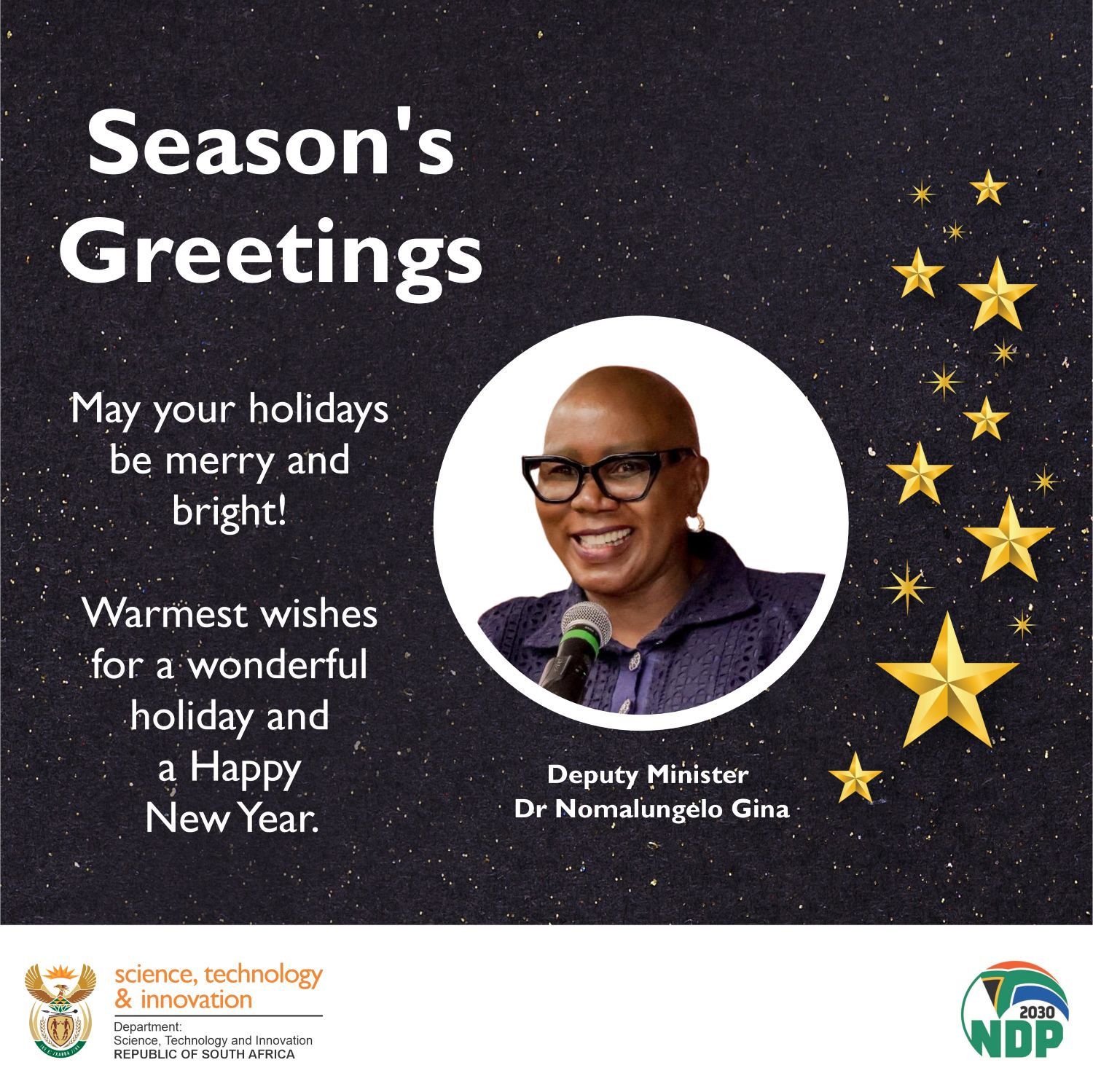
As the year concludes, the Deputy Minister extended her warm season’s greetings to all South Africans and wished them a safe, restful festive period and a productive and hopeful New Year.
Issued by the Ministry of Science, Technology and Innovation
For enquiries, please contact Veronica Mohapeloa at 083 400 5750 or This email address is being protected from spambots. You need JavaScript enabled to view it.


