
Africa’s giant eye on the sky marks two decades of discovery and astronomical excellence
On 10 November the Southern African Large Telescope (SALT), Africa’s largest optical telescope and one of the most powerful in the world, celebrated its 20th anniversary of astronomical excellence and breakthroughs. This flagship facility for South African and global astronomy was officially inaugurated in 2005 by the then President of the Republic of South Africa, Thabo Mbeki.
The milestone event was jointly hosted by SALT, the Department of Science, Technology and Innovation (DSTI) and the South African Astronomical Observatory (NRF-SAAO), a national facility of the National Research Foundation, in Sutherland, Northern Cape, where SALT continues to operate. The commemorative celebration brought together dignitaries, prominent astronomers and scientists, as well as the representatives from international partners to reflect on SALT’s scientific impact and enduring legacy.
In his welcome address Prof Brian Chaboyer, SALT Board Chair said SALT was the first South African built optical telescope, a decision he described as courageous on many levels, since previous optical telescopes had all been built outside the country. “Motivated by an ambitious science white paper from the new government, there was a plan for South Africa to build and operate the largest single optical telescope in the Southern Hemisphere.”
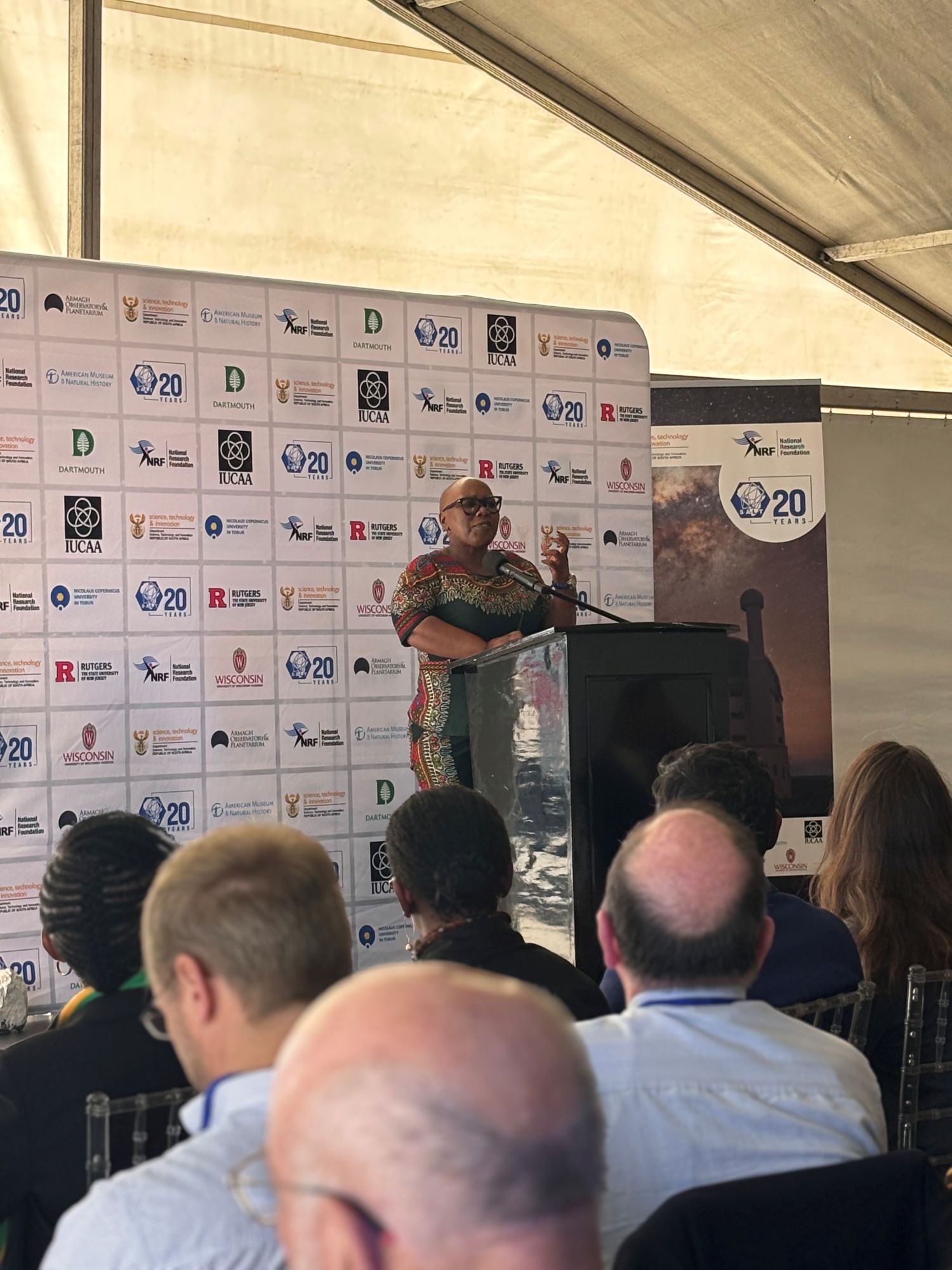
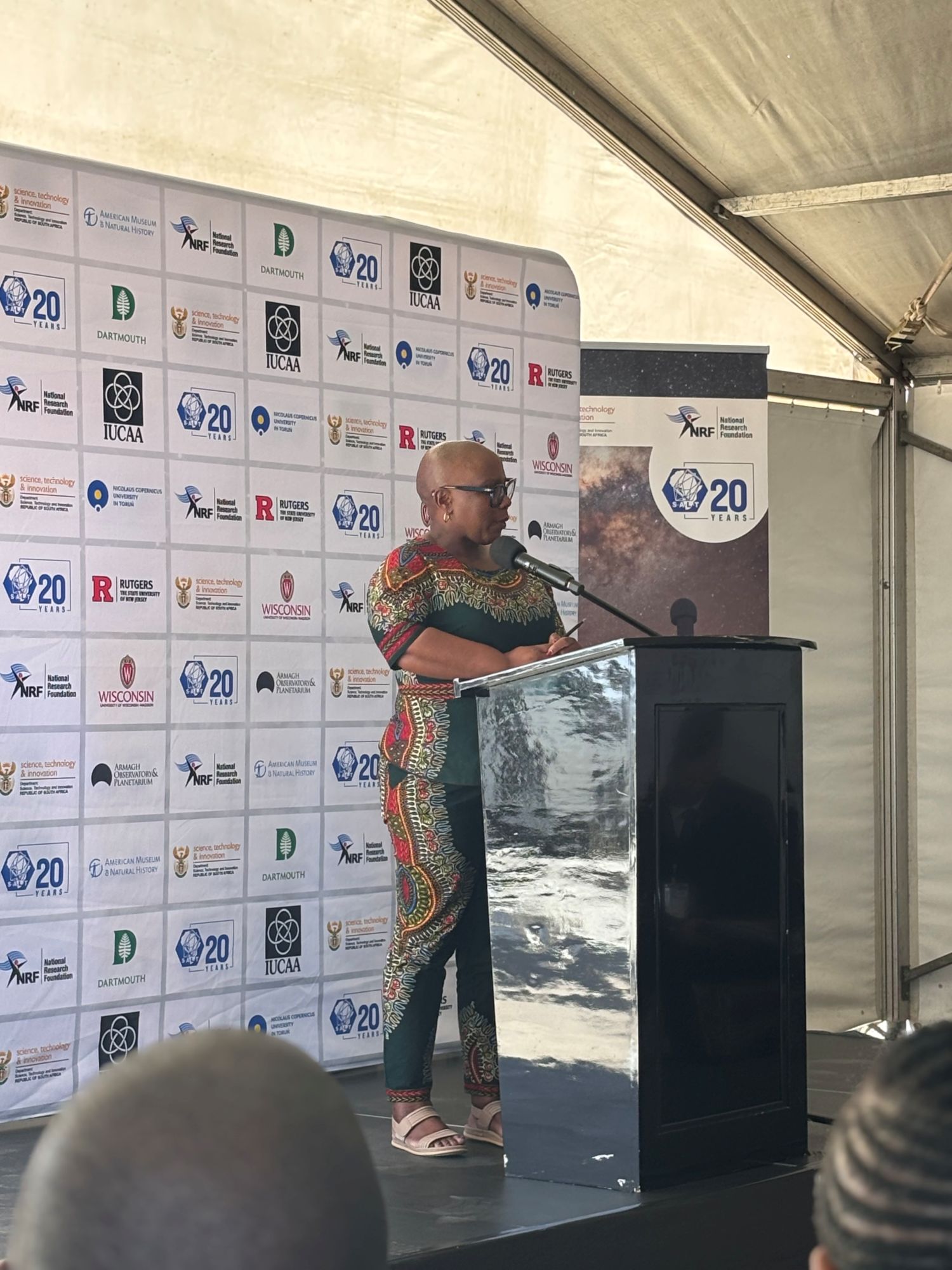
Delivering the keynote address, Deputy Minister of Science, Technology and Innovation, Dr Nomalungelo Gina, said the democratic government’s decision in 1998 to fund SALT’s construction was a defining moment for South African science. “SALT was built to serve both science and society, linking frontier research with education, technology and socio-economic development. It showed that big science can drive national progress.”
As South Africa looks ahead, Dr Gina reaffirmed the Department’s commitment to sustaining and expanding the country’s global leadership in astronomy. “SALT’s 20-year journey is a story of vision, perseverance and excellence. We remain committed to ensuring it continues to shine as a beacon of African science, uniting research, education, and innovation for the benefit of humanity.”
She also said SALT is more than a telescope, but a symbol of what is possible when vision, investment and international cooperation come together in pursuit of knowledge and progress.
Speaking on behalf of the NRF, NRF Board Chair, Prof Mosa Moshabela, emphasised that the conception of SALT was not only a scientific ambition, but a governance decision of courage. “It represented a conviction that South Africa could build and sustain a world-class research facility and, through it, redefine its place in global science. He further added that the NRF leadership championed that vision and provided the stewardship needed to make it real. “From conception to construction, and through two decades of operation, the NRF has remained the principal shareholder, funder, and custodian of SALT’s success.”
Prof Moshabela also highlighted that behind every discovery made by SALT is a person: a student, a technician, an engineer, a scientist whose growth tells a parallel story of progress, adding that it has been as much a laboratory for science as a workshop for people. “Over fifty doctoral theses have been produced using SALT data, and hundreds of students have gained hands-on training at the Observatory. Many of them now occupy leading positions in research and technology, locally and abroad.”
Affectionately known as Africa’s Giant Eye on the Sky, SALT remains the largest single optical telescope in the Southern Hemisphere, capable of detecting light from celestial objects a billion times too faint to be seen with the naked eye. Originally conceptualised in the late 1990s as a bold national scientific endeavour, the project became a reality in 1998 when the South African government committed US$10 million towards its construction. Completed in 2005, SALT entered full scientific operations in 2011 and has since delivered groundbreaking research that continues to shape our understanding of the universe.
Over the past two decades, SALT has achieved numerous astronomical milestones, including:
• Kilonova of GW170817 (2017): Among the first telescopes to capture the optical afterglow of a neutron star merger, contributing critical data to confirm theories of heavy element formation.
• Exoplanet Microlensing (2019): Supported the characterisation of newly discovered exoplanets, showcasing SALT’s capacity for rapid follow-up spectroscopy.
• Eight Super-Hot Stars Unveiled (2020): Identified eight new extremely hot subdwarf stars, advancing understanding of stellar evolution.
• “Peekaboo” Galaxy Discovery (2022): Characterised an ultra-low-metallicity galaxy offering a rare local glimpse into early-Universe conditions.
• Four-Star Multi-Stellar System (2023): Confirmed the gravitational binding of a unique quadruple star system, informing theories of multi-star formation.
As SALT embarks on its next decade, its partners and international collaborators remain committed to expanding the telescope’s scientific reach and strengthening South Africa’s role as a hub for cutting-edge astronomy.
Media Enquiries:
Dumile Mlambo
Manager: Corporate Communications, National Research Foundation
Email: This email address is being protected from spambots. You need JavaScript enabled to view it. / Cell: +27 78 313 5798
Veronica Mohapeloa
Media Liaison, Office of the Deputy Minister of Science, Technology and Innovation
Email: This email address is being protected from spambots. You need JavaScript enabled to view it. / Cell: +27 83 400 5750
ENDS.________________________________________