
Shaping science through transformation, inclusivity and partnerships
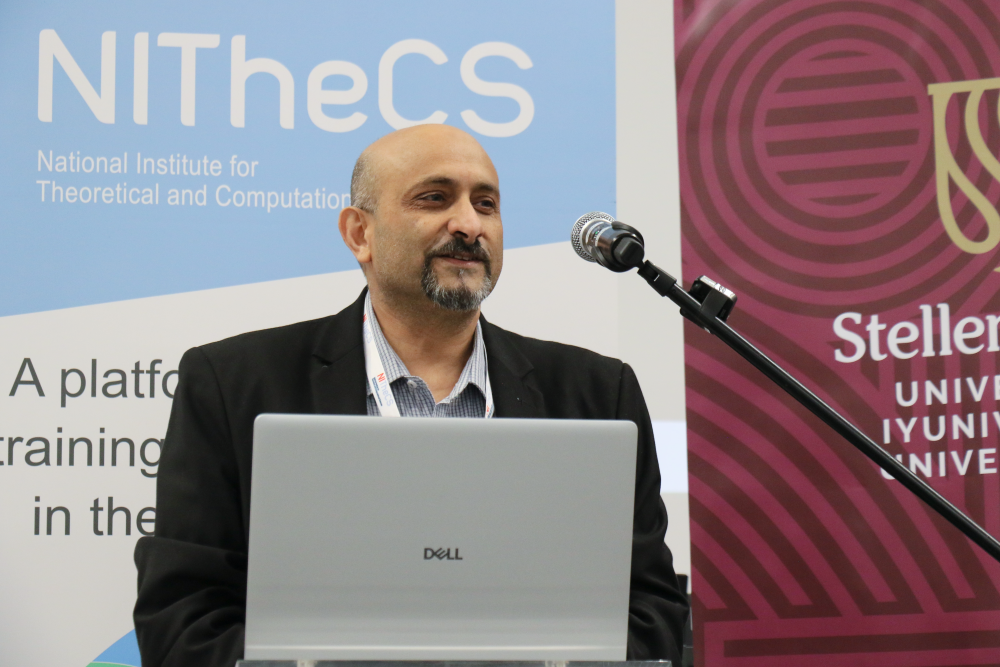
On 10 September 2025, Prof. Deresh Ramjugernath, Rector and Vice-Chancellor of Stellenbosch University, described NITheCS as "set to become a beacon of collaboration, a beacon of outreach and a beacon of innovation", one that would "inspire new research directions" and expand networks "across the country, the African continent and globally".
He was speaking at the official opening of the headquarters of the National Institute of Theoretical and Computational Sciences (NITheCS), part of a three-day theoretical and computational sciences event held from 9 to 11 September 2025.
NITheCS is a multidisciplinary and multi-themed institute working to develop human and research capacity in the theoretical and computational sciences, and enhance scientific innovation, transformation and socio-economic development in South Africa and the rest of the continent. It is funded by the Department of Science, Technology and Innovation (DSTI) and managed by the Department's entity, the National Research Foundation.
Prof. Ramjugernath said, "At Stellenbosch University, we are guided by our Vision 2040, which aspires to position the institution as a leading research-intensive university, globally recognised for excellence and relevance. The work being done through NITheCS and this hub is closely aligned with that vision. Importantly, this hub demonstrates the power of partnerships that can truly make a difference in society. It brings together all 26 universities in South Africa around an important initiative in science, technology and innovation, setting an example of what we can achieve through collaboration," he said.
He described the opening as about "more than a new office space; it is a statement of intent. NITheCS represents a shared investment in scientific excellence, building capacity for future generations and ensuring inclusion across the theoretical and computational sciences."
Representing the DSTI, Deputy Director-General: Research Development and Support, Mr Imraan Patel, explained that the Department's trajectory for the next few years was informed by the White Paper on Science, Technology and Innovation (STI) and the STI Decadal Plan (2022-2032).
"While these documents contain a number of details, the main emphasis for today can be summed up in three watchwords, namely, transformation, inclusivity and partnerships," he said.
On the issue of transformation, Patel noted that much more still needed to be done, particularly in achieving demographic transformation at the core of research, which continued to be a challenge. The latest annual STI Indicators Report, soon to be released, showed some concerning trends and highlighted the need to accelerate progress in this regard.
While the Presidential PhD Programme, the South African Research Chairs Initiative and other instruments all made a solid contribution to demographic transformation, the real challenge lay in scaling, strengthening and expanding the instruments. Initiatives such as NITheCS did this through skills development and training.
Patel said that inclusivity was a central focus for the Department. "Over the past several months, it has become evident that the national science system is not well understood by many, despite the wealth of activity taking place both in and outside the DSTI. To address this, the Minister has emphasised the need to place STI at the centre of government, industry, education and society. Turning this vision into reality requires more than a slogan; it demands concrete actions that make STI more transparent, accessible and visible."
He said that inclusivity extended to fostering transdisciplinary approaches and maintaining a strong commitment to open science. South Africa's open science strategy had been shaped to ensure that the country's approach remained relevant and responsive in the face of global shifts.
Patel stressed the importance of understanding the full landscape of existing partnerships and finding ways to maximise their impact. Institutions like NITheCS, he noted, provided an excellent case study of how collaboration could shape the way forward. He highlighted the need to raise the profile of such institutions to ensure that their work was built upon and expanded, and to engage with other sectors to help make the case for increased funding and to inform sound policy.
Prof. Francesco Petruccione, Director of NITheCS, described the official opening as the start of realising a shared vision for science in South Africa. He highlighted the importance of theoretical and computational sciences in driving innovation, citing breakthroughs such as quantum communication. Noting that scientific progress required long-term commitment, he said that science thrived on imagination, interdisciplinarity and embracing uncertainty. In his opinion, Africa should take a leading role in advancing global science and technology.
He explained that NITheCS was a consortium of all universities in the country, designed to empower the scientific community collectively rather than individually. Partnerships, both national and international, were central to NITheCS's success. It was necessary for scientists to collaborate and unite in efforts to address global challenges and contribute to the UN Sustainable Development Goals.
"With more than 400 associates across a variety of disciplines, the institute is building 10 impactful research programmes spanning areas such as quantum technologies, climate change modelling, machine learning and cosmology," Petruccione said.
Prof. Mervyn Christoffels, Director of the Centre for High Performance Computing (CHPC), was another speaker who emphasised the importance of partnership. Working together, the CHPC and NITheCS had created a powerful synergy, combining advanced digital infrastructure with research and training expertise to tackle South Africa's scientific and societal challenges. Together, the partners had built a pipeline of skilled talent through initiatives like the Coding Summer School, connected students and researchers to global networks, and strengthened capacity in areas such as climate science, astrophysics and bioinformatics.
"By integrating world-class computing resources with innovative training, this collaboration not only democratises access to cutting-edge research tools, but also positions South African science as a meaningful contributor on the global stage," Christoffels said.


