
Quantum Cats, technology, and the people: Two-Day symposium celebrates the International Year of Quantum Science and Technology
Scientists, policymakers, educators, students and members of the public met last week for a two-day symposium exploring the evolving relationship between science and society, and imagining the future of quantum science and technology in Africa.
The Nelson Mandela University (NMU) Theoretical and Computational Sciences Forum took place from 17 to 18 July in Gqeberha, in collaboration with the Department of Science, Technology and Innovation and the National Institute for Theoretical and Computational Science.
The thought-provoking event marked the International Year of Quantum Science and Technology, celebrating a century since the initial development of quantum mechanics.
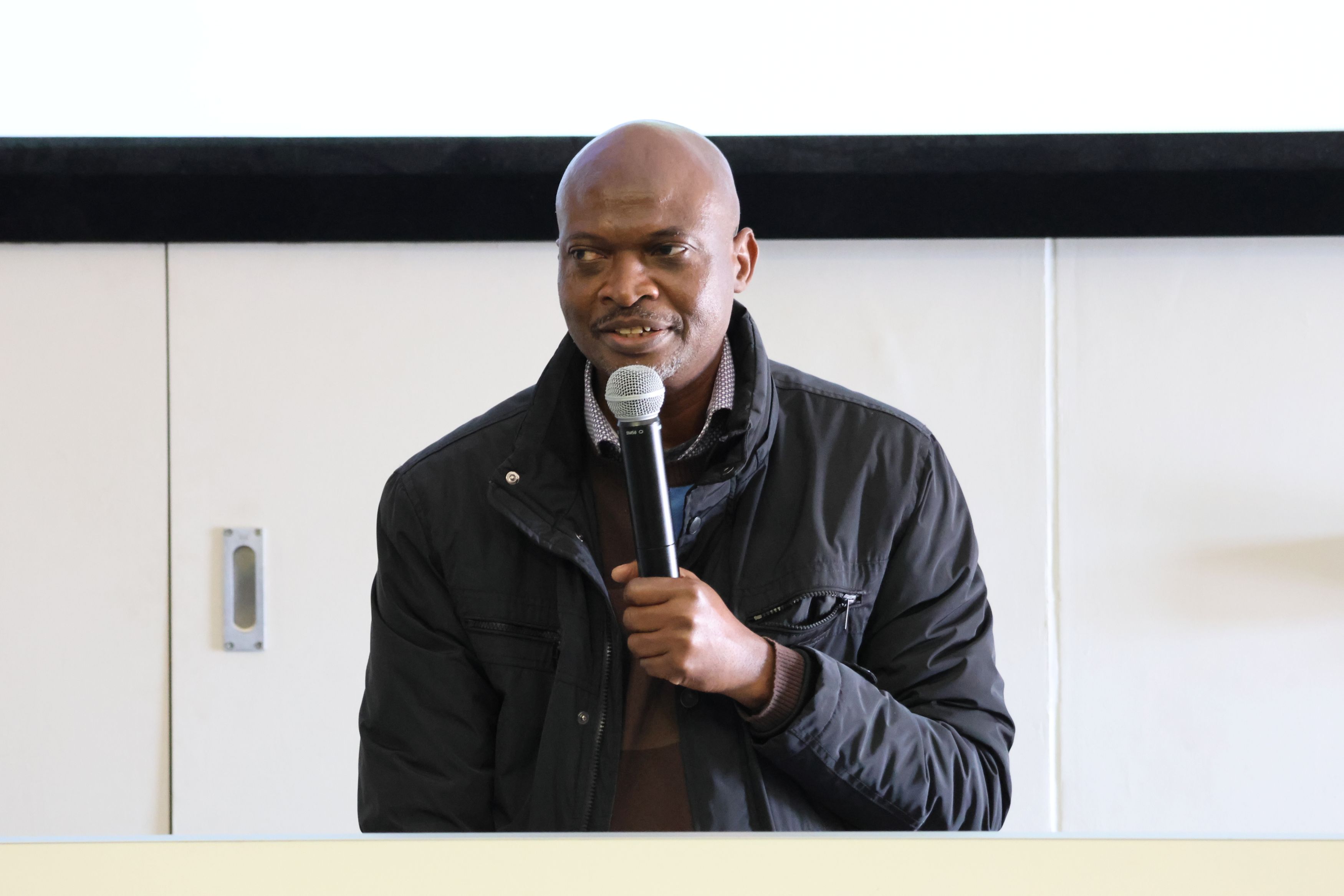
On the first day, the forum tackled a common challenge with a session on "Bridging the Gap Between Science and Society". Welcoming delegates, Prof. Azwinndini Muronga, NMU's Deputy Vice-Chancellor: Research, Innovation and Internationalisation, set the tone for the gathering by emphasising the importance of connecting scientific progress with societal needs.
"We are gathered to celebrate not only the International Year of Quantum Science and Technology, but also the International Decade of Sciences for Sustainable Development," said Prof. Muronga.
The International Decade of Sciences for Sustainable Development, which runs from 2024 to 2033, is a global initiative proclaimed by the UN General Assembly to harness the power of all of the sciences to advance sustainable change to societies, economies and the environment.
A presentation of findings from the South African Public Relationship with Science survey, presented by Dr Vijay Reddy from the Human Sciences Research Council, painted a picture of the situation in South Africa.
The survey, aimed at assessing public attitudes to, knowledge about and engagement with science across South Africa, found a strong correlation between higher income and optimism in science, with younger, more educated individuals showing higher levels of trust and enthusiasm.
Despite socio-economic differences, South Africans share broadly similar attitudes to science and technology. About 70% of the survey's respondents believe science improves society, particularly in areas like health and work. However, 80% are anxious about the pace of technological change, citing fears around job losses, inequality and the effect of science on religion.
While the survey found that universities and research institutions are more trusted sources of scientific knowledge than government or traditional leaders, only 50% of respondents believe scientists are honest about their work. A concerning 60% believe scientists harm people and animals, suggesting a growing problem with the scientific community's image.
"Scientists must come down from their ivory towers," urged Dr Reddy, calling for more engagement with the public.
However, 75% of respondents agreed that science is useful to the world, and identified key areas in which science could make a difference – electricity supply, education and access to clean water and healthy food. These insights offer a clear roadmap for aligning scientific research with public expectations.
The second day of the symposium delved into the world of quantum science and technology, offering a simple analogy to help demystify quantum computing for the non-expert. Classic computers use bits (0s and 1s) to process information, solving problems step-by-step, like walking through a maze with a flashlight. In contrast, quantum computers use qubits, which can be both 0 and 1 at the same time (a phenomenon known as superposition), allowing them to explore multiple paths simultaneously, like sending thousands of people with torches to explore the maze at once. This powerful capability promises to revolutionise fields such as medicine, cryptography and space science.
NMU's Prof. Darelle van Greunen shared her vision of quantum computing transforming cancer research and treatment, enabling earlier detection and more precise interventions. However, she also highlighted challenges such as the need for extreme cooling, a skills shortage and the importance of specialised education.
Nicholas Pather, from the University of Cape Town, explained quantum cryptography using the BB84 protocol, which uses quantum physics to create ultra-secure communication channels. This technology is seen as a vital tool in the fight against cyber threats.
Prof. Martin Weigt looked at how quantum mathematics pushes the boundaries of pure mathematics, and Lerato Seabi showed how quantum mechanics helps scientists understand cosmic phenomena like supernovae, linking quantum physics to the mysteries of the universe.
The University of KwaZulu-Natal's Prof. Thomas Konrad emphasised the importance of pan-African collaboration in quantum science. He announced the formation of the African Quantum Alliance, a network aimed at fostering knowledge sharing, training and capacity building across the continent. "Africa must not be left behind in the quantum revolution," he said.
In his closing address, Prof. Muronga drew on the Schrödinger's cat thought experiment (the cat, enclosed in a box, is both dead and alive until it is observed) to reflect on leadership and transformation. He likened organisations and people to quantum systems in superposition, where multiple futures coexist until decisions are made.
"It takes courage to open the box," he said, emphasising the need for clarity and decisive action in navigating uncertainty.
The symposium was more than a celebration of science; it was a call to bridge the gap between science and society, and to harness quantum technologies for sustainable development. As quantum science moves from theory to real-world application, the message was clear: science must serve people, and people must be part of the scientific journey.
With growing interest in quantum technologies across Africa, and a public that sees both promise and peril in scientific progress, the time is ripe for inclusive, responsible and collaborative innovation.