
We need to empower women and girls in science now for a brighter future
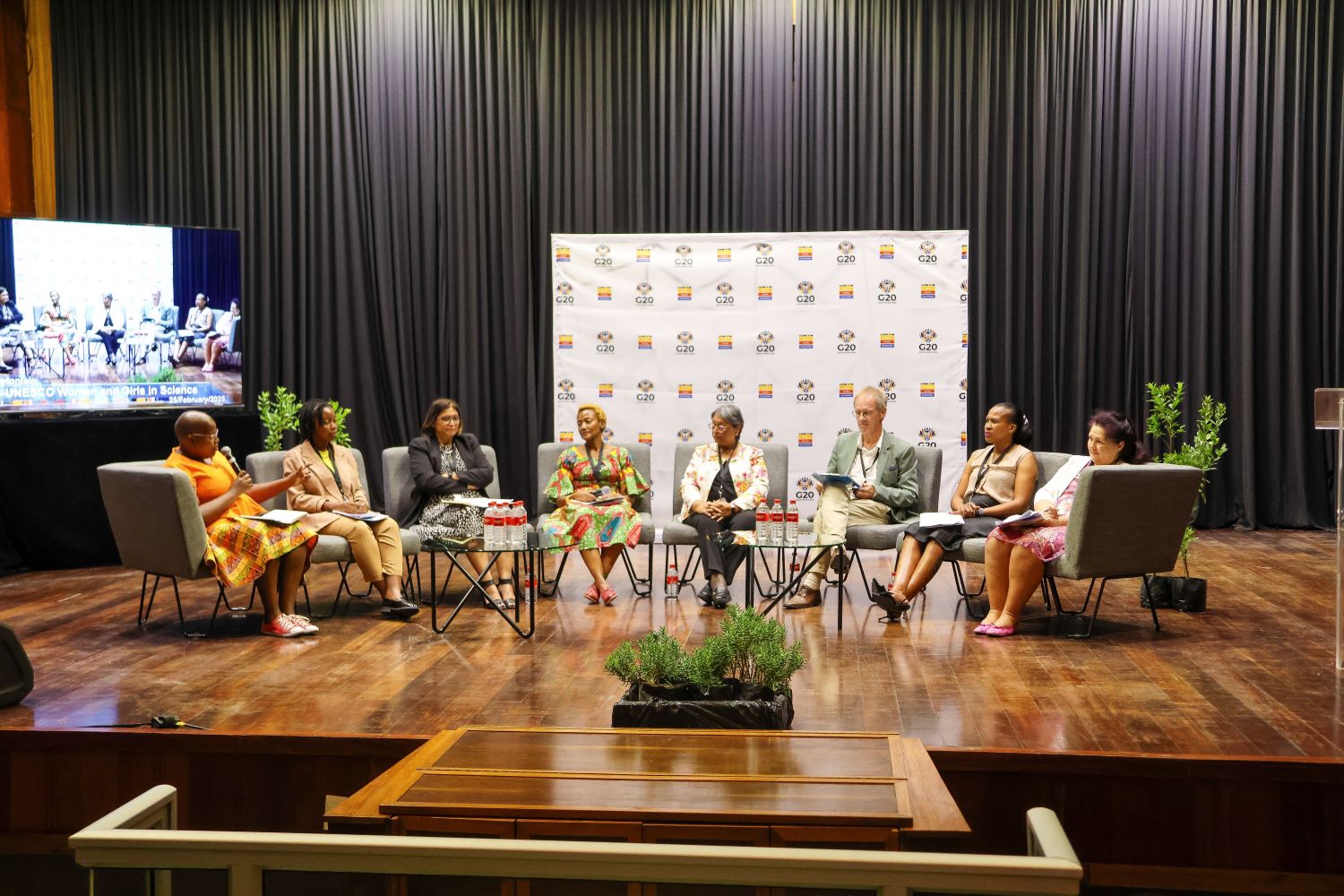
Science in the 21st century is a powerful tool for solving global challenges, said UNESCO's Chief of Section for Science, Technology and Innovation Policy, Dr Ezra Clark, at the UNESCO Women and Girls in Science side event on 25 February 2025.
The event took place at the University of Free State and concluded the first G20 Research and Innovation Working Group (RIWG) meeting.
The theme of the side event was "Shaping a brighter future for women and girls in science".
Clark said that, at its best, science is dynamic, collaborative and diverse. "But for science to reach its full potential, it must be inclusive. This is why the International Decade of Science for Sustainable Development (2024-2033) calls for strengthened global cooperation in science, with gender equality as a central pillar," he said.
Clark's insights resonate with UNESCO's recent report, "Changing the Equation," which reveals that women constitute only 22% of the science, technology, engineering and mathematics (STEM) workforce in G20 countries – a figure that has seen minimal growth over the past decade.
The report also highlights significant pay disparities and limited career advancement opportunities for women in these fields. To combat these challenges, UNESCO calls for comprehensive measures, including eliminating gender biases in educational materials, providing gender-sensitive career guidance, and implementing policies that facilitate a balance between women's professional and personal responsibilities.
Hosted by the Department of Science, Technology and Innovation (DSTI), the G20 RIWG is a high-level platform in which leading economies tackle pressing challenges through cutting edge research, technology and innovation. It was hosted alongside the G20 Initiative on Bioeconomy from 23 to 25 February 2025.
Addressing delegates, Mr Imraan Patel, the DSTI's Deputy Director-General for Research Development and Support, stressed the importance of inclusion across a wide range of dimensions. As part of that inclusion agenda, Patel emphasised the importance of women in science.
"Accelerated action is certainly required since we have faced numerous problems, such as the value of diversity and inclusion, and our experience has demonstrated that we cannot establish the type of society that we seek on the backs of a few. The issues we face necessitate the efforts of everyone. The challenges we confront cannot be handled until we address issues of diversity and inclusion," said Patel.
For him, a far more systemic approach to the challenges of female representation in science is needed. He identified deep-seated challenges such as workplace culture, the nature of industry, funding support, and mentoring.
Mr Patel highlighted the necessity of integrating gender considerations into all facets of scientific research and innovation. He advocated for policies that not only encourage women's participation in STEM but also ensure their retention and progression into leadership roles.
Paying tribute to Ms Senamile Masango, South Africa's first Black female nuclear scientist, who passed away on 10 February 2025, Prof. Sarah Mosoetsa told delegates that, while Ms Masango's death is a profound loss, her legacy serves as a reminder of what is possible when women are given opportunities to lead in STEM and innovation. In 2015, Ms Masango launched Women in Science and Engineering in Africa, an initiative that provides mentorship to young girls in schools to encourage them to take up careers in science.
Prof. Mosoetsa, CEO of the Human Sciences Research Council, noted that STEM, along with the humanities and social sciences, are the engines of progress, shaping the future of our societies, economies, and the well-being of our people.
Yet, despite decades of advocacy, policy interventions, and growing awareness, women remain significantly underrepresented in these fields. "This is not just a loss for women – it is a loss for science, for innovation, and humanity as a whole," she said.
"We must act decisively," she said, describing three key policy interventions that can help accelerate progress. These are targeted funding for women, gender and race-responsive institutional reforms, and global mentorship and leadership networks.
South Africa's G20 presidency, reiterated Prof. Mosoetsa, provides everyone with a unique opportunity to move from dialogue to action.
"Let us reaffirm our collective responsibility to dismantle the barriers that limit women's full participation in STEM, especially those who face the compounded effects of race, gender and class inequality," she said.
"As we honour Senamile Masango's remarkable contributions, let us commit to ensuring that the path she paved remains open for many more to follow. May her life's work inspire us to redouble our efforts, not only to celebrate the achievements of women in STEM but to actively create the conditions for their success," she concluded.
Ms Rovani Sigamoney, Education Program Specialist at UNESCO, highlighted that one of the biggest challenges in science education is the exclusion of women and girls.
According to a 2015 UN survey conducted in 14 nations, the chance of female students graduating with a bachelor's degree in a science-related subject is 18%. For a master's degree, the figure is 8%, and just 2% for a PhD. Male students, however, have a 37% chance of graduating with a bachelor's degree, 18% for a master's degree and 6% for a PhD. She says it will take five generations to achieve gender equality.
"A lack of women in the technology workforce is an economic loss to society," she said.
Sigamoney urged for a complete review of STEM policies to ensure a gender component, pointing out that, while 68% of countries have STEM policies, only half support women and girls.
According to Ms Naadiya Moosajee, co-founder of Women in Engineering (WomEng) the contextual factors that influence women's advancement in engineering include raising awareness of STEM from a young age, then progressing to high school and university. The next step is to create physical and virtual spaces for women in industry and women innovators, and, finally, onto ownership.
WomEng is a social enterprise developing girls in STEM and women in engineering in multiple countries. "We work in some of the hardest industries with some of the best economic opportunities on the continent and around the world. To ensure that we not only have the skills but also the ownership of these industries, we must broaden the debate about women in STEM leadership to encourage more women to own STEM sectors, since ownership leads to true transformation," noted Moosajee.
"If we truly want to expedite change, I urge everyone to join us to make a difference on the ground so that we may achieve the gender parity we are talking about today in the next 10 years," concluded Ms Moosajee.


