

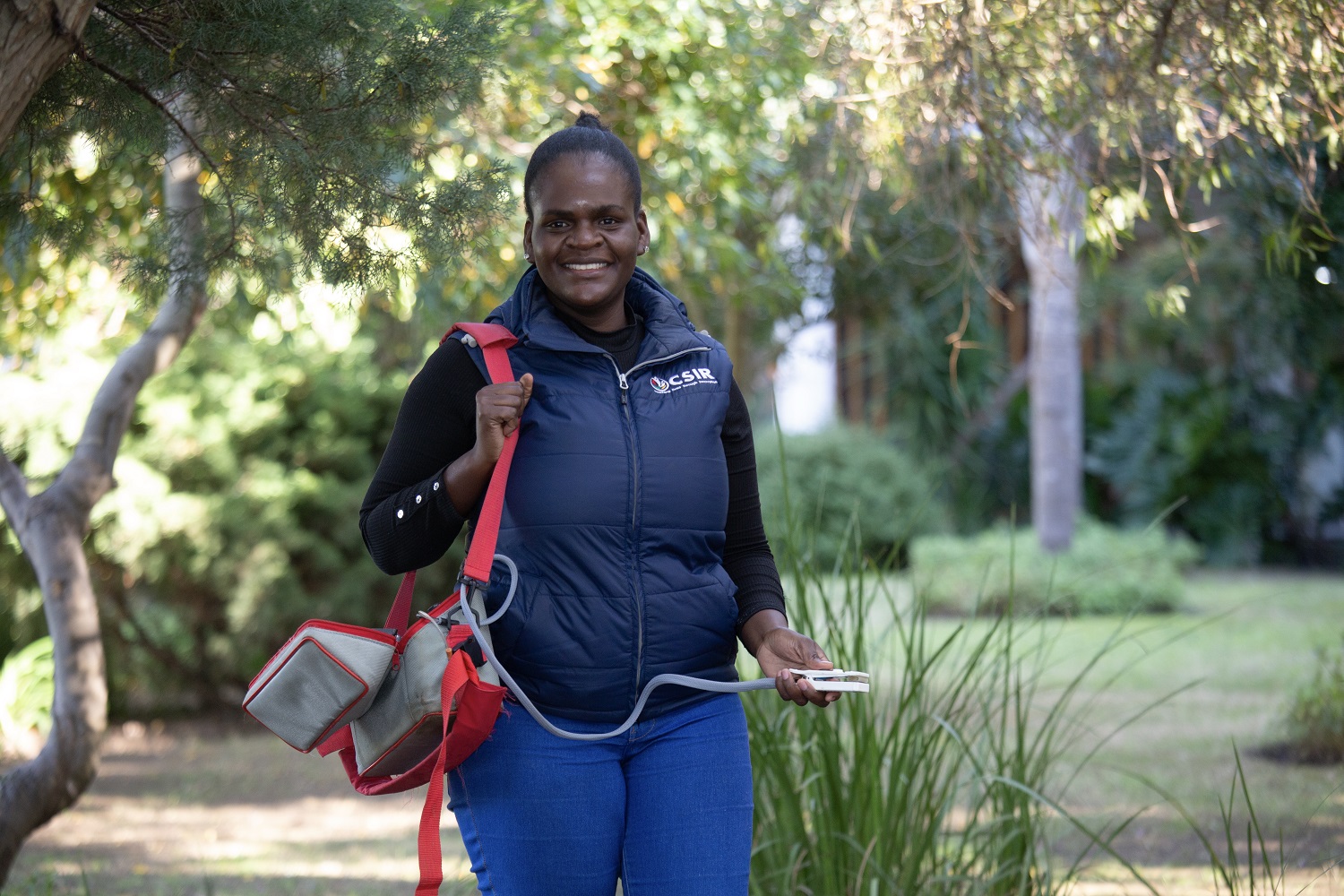
Celebrating Women's Month 2023 under the theme "Accelerating socio-economic opportunities for women's empowerment"
Growing abundance through water research, technology and innovation
As the country marks Women's Month, the Department of Science and Innovation is celebrating phenomenal women who are making their mark in the science, technology and innovation sector.
For Dr Nompumelelo Mobe, childhood memories of enduring hardship to fetch water from the nearest river for her home played a key role in choosing her career. She was born and raised in Botlokwa, a small village north of Polokwane in Limpopo.
"To access water meant covering long distances with a wheelbarrow or carrying a bucket and asking neighbours to assist to reach the nearest river," she says. "Even in contemporary times, for rural households to have direct access to water requires having a borehole to access groundwater. Accessing water in rural areas is no small feat," she says.
Mobe registered for a BSc in agriculture at the University of Limpopo in 2010, majoring in agronomy with a focus on food security. She completed her MSc in agriculture in 2016, which led to an internship at the University of Venda. She successfully received a Council for Scientific and Industrial Research (CSIR) Professional Development Programme doctoral internship in 2016 and joined the CSIR the following year.
It was during the internship that she decided that she wanted to specialise in water-related research. In May 2021, she obtained a PhD in environmental and water science. Mobe's research focused on water conservation in agriculture and the water use for crops – also known as agricultural water management.
Irrigated agriculture uses 70% of the world's fresh water, but Mobe feels that the importance of water and water conservation technologies in agricultural production processes is overlooked. "Emerging topics such as climate change and the use of pesticides in agriculture processes tend to be given more exposure and priority in research," she says.
Her research informs and assists farmers in quantifying the amount of water needed to compensate for the loss to the atmosphere. Because crop production and the management of natural resources are intertwined, Mobe actively leads research activities with diverse stakeholders, including government and farmers, on how to use water sustainably for improved access and availability of water resources.
Mobe describes being part of a predominantly women-led water research team as a fantastic experience. "Our regional team is equipped with a range of different educational and academic backgrounds. This allows all of us to contribute in specialised and meaningful ways. We are learning a lot from each other, which has been fantastic," she says.
She believes there is room for improved representation and empowerment of women scientists in this field. She is as passionate about increasing awareness of the importance and value of water in agriculture at the tertiary education level as she is about ensuring that women researchers are represented in this unique area of research.
"New scientific and technological approaches to water use and reuse, treatment and management are urgently needed," Mobe says. "This requires research into many areas."
The CSIR contributes to providing reliable, efficient and functional water and wastewater service delivery in the interest of economic development, through developing and refining smart water use and infrastructure technologies for the public and private sectors.
"From 2016 to 2017, when the Western Cape was facing a possible drought, freshwater dams had dropped below 25% of capacity, and levels continued to fall. Stakeholders and the government approached the CSIR for advice and input on tackling the water scarcity problem. The CSIR managed to secure Water Research Commission funding for a project that focused on the use of water in the production of apples. Locally, most apples are produced under irrigation in the Western Cape," she says.
Due to the water restrictions at the time, farmers were concerned about how production processes in the apple industry would be affected as South Africa is ranked as the sixth-largest exporter of fresh apples in the world. "Because the CSIR was able to assist, the deciduous fruit industry leaders were more than willing to supplement the funding from the Water Research Commission," says Mobe.
The CSIR assisted the deciduous fruit industry with decisions relating to its limited water and how to use water as a resource in a sustainable way. "There was no running out of water despite the looming 'Day Zero' at the time, because water was managed and saved," she says.
Modern agriculture faces many complex challenges and managing water use in farming practices is a crucial aspect of successful farming. Needing to do more with less water will require a multitude of skills sets, one of which is software development. Mobe feels it is a career that would serve water research well.
"As researchers, we gather the data and produce reports on our findings for our various clients to use, but there is room to do more with the available data. There is more value that can be created from the data, as well as from the data sets in the archives. The data gathered can be used to create technologies and spark innovation, and we need software developers who can develop software to predict water use or the quality of water in South Africa." Similarly, computer scientists can add value by transforming the agricultural sector using new technologies to assess the water requirements and time of supply of crops, as an example.
"I enjoy doing fieldwork," says Mobe. "Being able to advise farmers about water and assisting them with related decisions fulfils me. It is extremely rewarding to experience how much the farmers look up to water researchers at the CSIR. Knowing how much we are able to help them brings me a lot of personal satisfaction."


