
Celebrating Youth Month : Cross-disciplinary postgraduate e-science training platform
Young people in computer science, mathematics, applied mathematics, actuarial sciences, and physics, among others embracing technologies of the future
The COVID-19 pandemic has fast-tracked the uptake of technologies of the fourth industrial revolution (4IR). The need to contain the virus through strict lockdown measures implemented across the world, has seen the majority of industries resort to virtual methods of doing business or face closure.
However, long before the outbreak of the deadly pandemic, and in preparation for the 4IR, many institutions of higher learning introduced courses to equip the country’s young people for the global technology revolution.
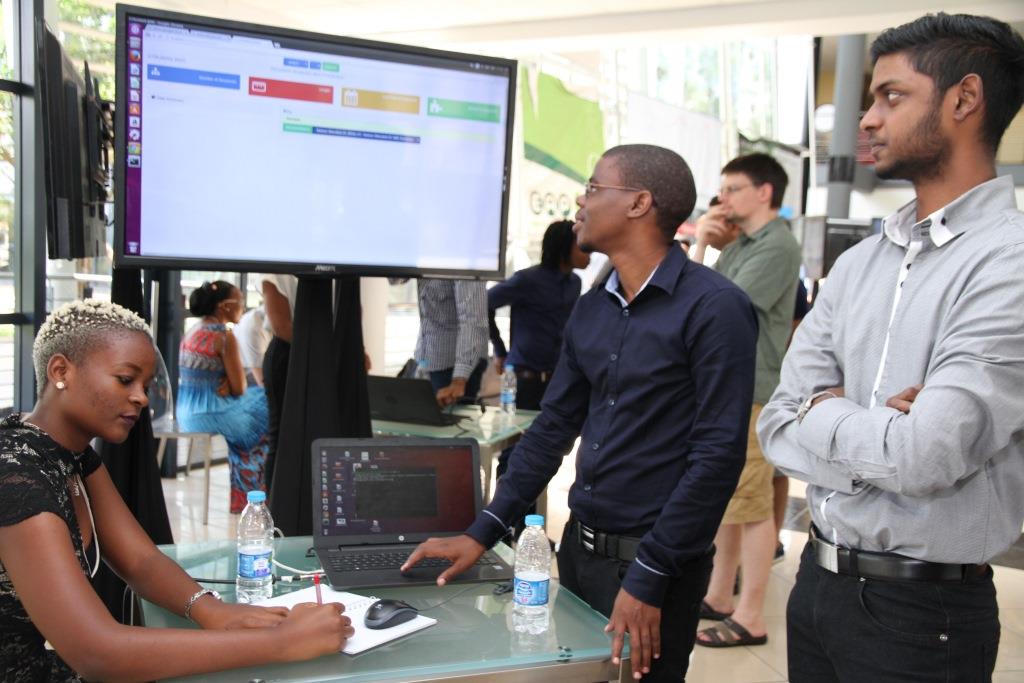
The University of the Witwatersrand (Wits), is one several that is hosting a unique cross-disciplinary postgraduate e-science training platform. Wits, in partnership with the Universities of Limpopo, North-West, Pretoria, Sol Plaatje and Venda has formed a consortium that supports e-science training platforms.
Launched in 2017, the National e-Science Postgraduate Teaching and Training Platform (NEPTTP) is intended to develop the knowledge and skills to conduct cutting-edge research in the field of e-science.
Funded by the Department of Science and Innovation through the National Integrated Cyberinfrastructure System, NEPTTP offers an MSc and an MA in e-science.
The programme aims to train postgraduate students in the use of a variety of methods for data-driven research in the natural sciences (MSc) or the social sciences and humanities (MA). It creates opportunities for students to develop an interdisciplinary perspective on the emerging fields of data science.
Perlate Diala, currently a junior analyst at Deloitte Consulting, was among the first cohort of 30 students enrolled in 2018. He graduated with an MSc in July 2020. The title of his master's thesis was "Prediction of customer churn in telecommunication using machine learning algorithms".
Explaining his research work, he says it compares the performance of various machine learning classifiers for the prediction of customer churn in telecommunication industry.
Diala explains that the loss of customers in telecommunication industries has become a major concern in recent years, owing to the steep competition among industries and the high cost of acquiring customers. It is therefore important to keep existing customers.
To prevent this, he says, effective and accurate models are needed to predict churn rate – the rate at which customers stop doing business with an entity. However, the large volumes of data and enormous feature space make it a challenge to build models for telecommunication.
One of Diala's research findings was that there was not much difference in the performance of models among the selected oversampling techniques.
In 2019 and 2020, the platform enrolled a further 60 students, explains Prof. Benjamin Rosman, NEPTTP Director and Associate Professor in the School of Computer Science and Applied Mathematics at Wits.
The NEPTTP programmes are unique because they cut across faculties. Their students come from a range of disciplines, including computer science, mathematics, applied mathematics, actuarial sciences, physics, statistics, engineering, social sciences and public health.
"We foresee the demand for such degrees increasing exponentially over the next few years," says Rosman.
Wits is the administrative hub of a consortium that includes the Universities of Limpopo, North-West, Pretoria, Sol Plaatje and Venda.
Students register with their home institution, but complete the coursework component of their degree at Wits in the first year. In the second year, the students move back to their home institutions to complete a research report.
Once qualified, successful students can look forward to career opportunities in academic institutions, social and policy research organisations (government and non-governmental) and the private sector (technology, healthcare companies and the finance sector).
Such careers involve everything from exploratory data analysis and applying statistical methodologies to deriving business insights from data. People in data-oriented positions will partner with product and engineering teams to solve problems, identify trends and opportunities, and inform, support and execute product decisions and launches.
"Our graduates are being employed at well-known organisations such as Absa Group, Amend.org, the Council for Scientific and Industrial Research, Deloitte, IBM, Rand Merchant Bank and Standard Bank," adds Rosman.
NEPTTP is currently in discussions with various public and private partners, including the Gauteng Department of e-Government, the Gauteng Department of Health, financial institutions and international partners, to facilitate an internship programme for graduating students.