
DSI-NRF Funds HIRAX Dark Energy Telescope
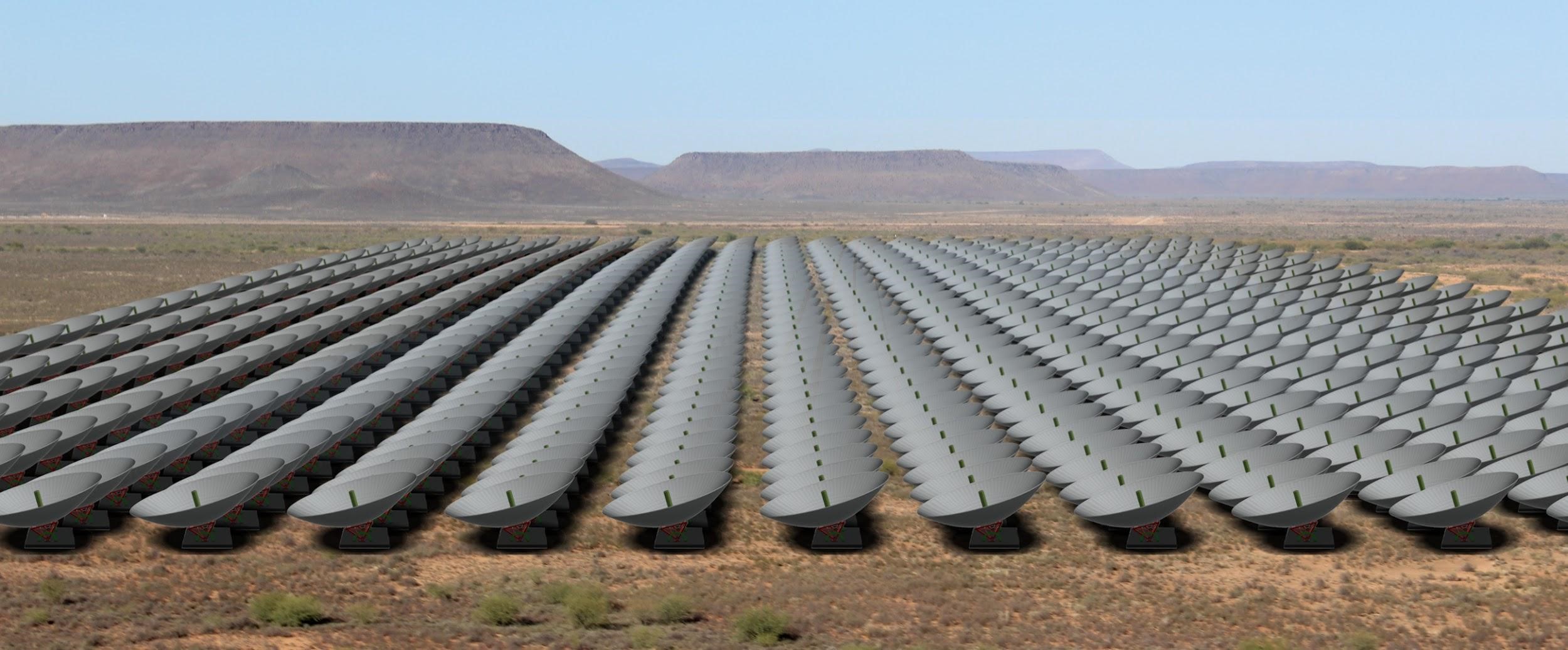
Following an intensive and rigorous review process involving international experts, the Department of Science and Innovation (DSI) and National Research Foundation (NRF) approved the funding of R35 million for the Hydrogen Intensity and Real-time Analysis eXperiment (HIRAX) which will be built as a guest instrument at the South African Radio Astronomy Observatory’s (SARAO) site in the Karoo.
The new radio telescope will bolster the country’s ability to perform cutting-edge astronomy research in alignment with the Grand Challenge Astronomy National Strategy. This new investment by the DSI, in partnership with the NRF, will provide funding for the telescope dishes, feeds, radio frequency over fibre system, and some backend hardware. This contribution represents a significant investment in the overall HIRAX project.
South Africa has a long history of successful radio astronomy and the future Square Kilometre Array (SKA), which will be hosted by both South Africa and Australia, is set to be the largest radio telescope in the world. HIRAX will provide training and skills development in anticipation of the SKA era while studying cutting-edge questions in the fields of dark energy, fast radio bursts, and pulsar science. The telescope is currently funded to be an interferometer array of 256-closely packed dishes that will provide an unprecedented peek into the history of our universe. There are also plans for possible future expansion to 1 024 dishes.
This state-of-the-art telescope will provide large astronomy data sets to the project's consortium members, international partners, and project collaborators.
Led by the University of KwaZulu-Natal (UKZN), under the leadership of the principal investigator Professor Kavilan Moodley, the HIRAX consortium consists of seven local members.
They include UKZN, SARAO, the African Institute for Mathematical Sciences, the Durban University of Technology, and Rhodes, Cape Town, and Western Cape universities. There are also five international consortium partners - McGill University, ETH Zürich, Université de Genève, École Polytechnique Fédérale de Lausanne, and West Virginia University, as well as 12 additional collaboration members including Botswana International University of Technology, Laboratoire Astroparticule & Cosmologie, University of British Columbia, the Canadian Institute for Theoretical Astrophysics, University of Oxford, University of Toronto, The Inter-University Centre for Astronomy and Astrophysics, the University of Wisconsin-Madison, Perimeter Institute, Carnegie Mellon University, Stellenbosch University, Jet Propulsion Laboratory, and Yale University.
Reflecting on the NRF’s University Flagship Programme which aims to provide customised, innovative solutions and institutional support in a way that recognises the unique strengths and niche research areas of public universities, Dr Gansen Pillay, the NRF’s Acting CEO notes that, “This investment in Strategic Research Equipment will further advance postgraduate student training, new knowledge generation and South Africa’s standing as a global leader in the field of astronomy.”
| Media Queries Candice Molefe Media & Internal Comms Manager NRF Corporate Communications Email: This email address is being protected from spambots. You need JavaScript enabled to view it. | Equipment-related Queries Prof. Kavilan Moodley HIRAX Principal Investigator University of KwaZulu-Natal Email: This email address is being protected from spambots. You need JavaScript enabled to view it. |


