
Minister Nzimande visits SKA site, home to global astronomy project
Local economic development and capacity building are among the hallmarks of the Square Kilometre Array (SKA) radio telescope project, said the Minister of Higher Education, Science and Innovation, Dr Blade Nzimande.
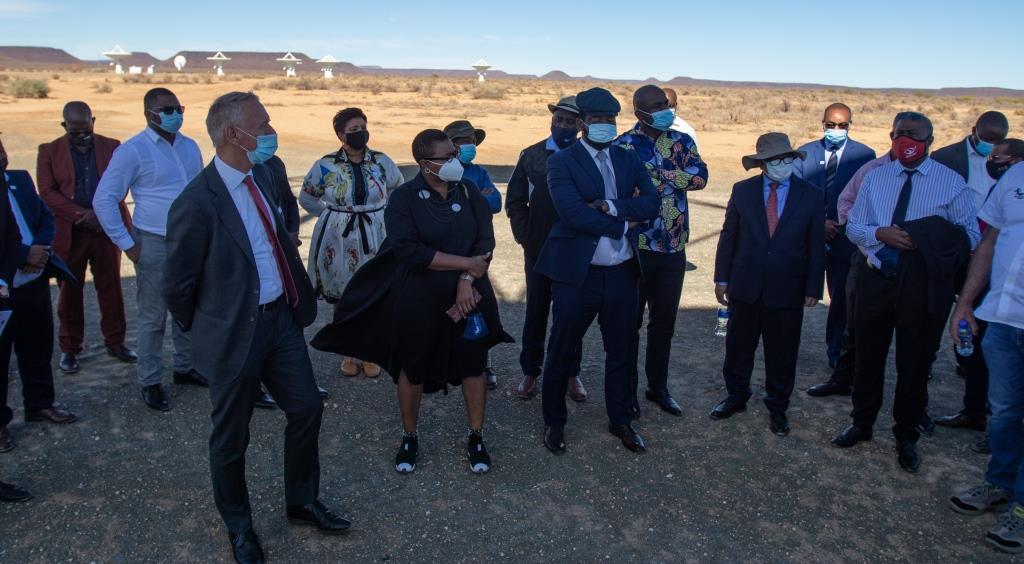
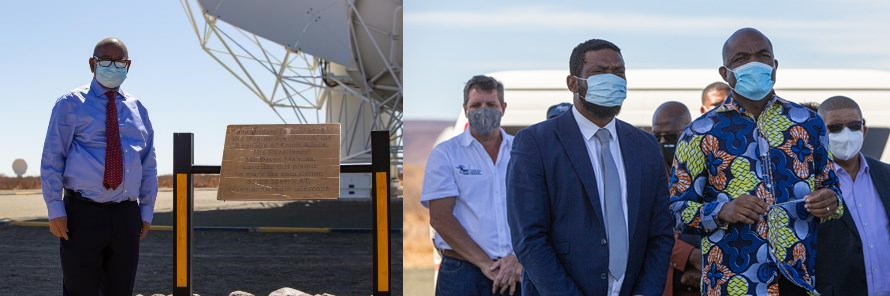
Visiting the SKA core site in the Karoo, Northern Cape, for the first time since being appointed Minister in 2019, Dr Nzimande was left awestruck by the initiative, which includes the 64-dish MeerKAT telescope, a precursor to the SKA.
The Minister gained firsthand insight into the amount of work that has gone into the the MeerKAT – funded by the Department of Science and Innovation (DSI) and operated by the South African Radio Astronomy Observatory (SARAO) – since South Africa won the bid to co-host the global SKA project in 2012.
The SKA is an international effort to build the world's largest radio telescope, which will eventually have a collecting area of more than one square kilometre, or one million square metres. It will eventually use thousands of dishes and up to a million low-frequency antennas to enable astronomers to monitor the sky in unprecedented detail, and to survey the entire sky much faster than any system currently in existence.
South Africa's Karoo region and Western Australia's Murchison Shire were chosen as SKA co-hosting locations for scientific and technical reasons, ranging from the atmospherics above the sites to their radio quietness, which comes from being some of the most remote locations on Earth. The Karoo will host the core of the high and mid-frequency dishes, ultimately extending over the African continent, while Australia's Murchison Shire will host the low-frequency antennas.
In South Africa, work is under way to extend the 64-dish MeerKAT telescope with an additional 20 antennas in partnership with Germany, Italy and China at a cost of R870 million.
Ultimately, about 133 antennas will be added to those of the MeerKAT, bringing the total to nearly 200 dishes, to form the SKA's mid-frequency telescope array. Most dishes will be concentrated in a core, with three spiral arms extending over 150 kilometres.
The latest discovery by the MeerKAT telescope was announced in January, when two giant radio galaxies were discovered that are among the largest single objects in the universe – further demonstrating the technological advancement of the MeerKAT.
Following his tour of the facility, Minister Nzimande addressed an audience that included a number of ambassadors to South Africa. The Minister said the project had huge potential, which included local economic development and, most importantly, human capital development in the Northern Cape.
Remarking on the big data being generated by the SKA project, the Minister said this presented an opportunity to train the country's young scientists in data analytics and related skills.
"The SKA will grow and make an even bigger impact," he said, adding that the COVID 19 pandemic had shown that "we are a country of science". The challenge now was "to educate people about the impact of science and excite our young people, as South Africa is a country of many opportunities". The SKA should be made known to people, Dr Nzimande said, and by working innovatively, SARAO could use e tourism to reach out to those who were not able to visit the site physically.
The DSI is collaborating with the Department of Tourism and the Northern Cape provincial government to establish a multi-purpose facility, the SKA Exploratorium, in Carnarvon. The facility will include a science visitor centre, SKA information centre and other amenities to take advantage of increased interest and science tourism opportunities resulting from the MeerKAT and SKA projects.
The Premier of the Northern Cape, Dr Zamani Saul, said the provincial government appreciated the investment in the province, which included the Sol Plaatje University. He said the facilities had the potential to change the conditions of the province, particularly of the communities around the SKA.
"What we need to do as the project goes ahead is to optimise those benefits to the hosting communities. This is a landmark project and a massive investment in the Northern Cape, which also contributes to job creation in the tourism sector," said Dr Saul, encouraging students to take up careers related to astronomy.
Priscilla Appies, a young woman from Carnarvon, is employed at the SKA site as an instrument control fitter following a three-year apprentice programme. Ms Appies set her sights on achieving success despite the difficult socio-economic conditions affecting her community.
"As an instrument fitter, we do fault finding on antennas and fixing faults on a daily basis," said Ms Appies, who qualified as an artisan in 2017 and is among a number of young people in Carnarvon who are benefiting from skills and academic development through the SKA.
"Had it not been for the SKA, I would not be where I am today," she said, adding that the project offered many opportunities and encouraged young people never to give up hope of securing a better life.