

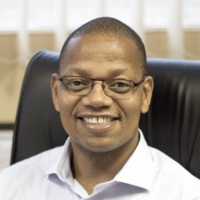
Prof. Langa Khumalo appointed to lead digital language research infrastructure
The South African Centre for Digital Language Resources, SADiLaR, a research infrastructure platform funded by the Department of Science and Innovation as part of the South African Research Infrastructure Roadmap, welcomed its new Centre Director, Prof. Langa Khumalo, on 1 August 2020.
SADiLaR, the first centre of its kind in Africa, was established to achieve the constitutional imperative to recognise all the South African languages as key resources. It supports the creation, management and distribution of digital language resources and relevant software.
Khumalo is the former Director of Language Planning and Development at the University of KwaZulu-Natal.
In 2016, Khumalo completed an intensive advanced leadership programme for higher education, which made him acutely aware of the challenges confronting higher education in terms of generating knowledge that is innovative and responsive to ever-evolving human needs.
Khumalo was introduced to working with language data in the early stages of his career, and was trained by many luminaries in corpus linguistics, including the late Prof. John Sinclair at the Tuscan Word Centre in Italy.
He was one of the first editors to compile and publish the first corpus-aided monolingual dictionary of isiNdebele.
Khumalo has been involved in various human language technology projects, including the development of the isiZulu national corpus, an isiZulu oral corpus and an English-isiZulu parallel corpus. These corpora are carefully designed to enable human language technology development, among other things. His involvement in projects such as the development of disciplinary terminology for isiZulu, which culminated in the publication of glossaries such as an illustrated glossary of architecture terms and a glossary of law terms, has contributed to raising awareness of the profile and role of African languages.
He sees SADiLaR as an attractive and inevitable destination for him, because of what it is doing, what it seeks to do in terms of developing language resources, and its national character and reach.
Khumalo has been involved with SADiLaR as a member of the Scientific Advisory Committee since its inception in 2017. Given his close association with SADiLaR, Prof. Khumalo has insight into all the projects that have been rolled out internally, as well as projects driven by the various nodes.
The centre has a dynamic team with an impressive array of skills, and Prof. Khumalo hopes that his experience and skills set will be a useful addition. He embraces the culture of high-quality research and productivity at the centre, and the links that it has already established.
Since its inception, SADiLaR has made strong connections with similar research infrastructures abroad, including the European Common Language Resources and Technology Infrastructure (CLARIN), the European Language Resources Association, and the Linguistic Data Consortium hosted by the University of Pennsylvania. SADiLaR has been guided by experienced leaders in the field of human language technology, linguistics and digital humanities.
Khumalo wants SADiLaR to produce research (technology) solutions and (digital) resources that are impactful and have transformational effect on the communities where a language is predominantly spoken and/or taught.
"Language is at the centre of our human existence. It carries and conveys the identity of humanity. It records our human achievements and spurs on our innovation and development. It is notable that our Constitution recognises 11 official languages. It is a constitutional imperative to develop all of them in order to achieve 'parity of esteem' between them," says Prof. Khumalo.
Important links:
Department of Science and Innovation:
South African Research Infrastructure Roadmap:
https://www.dst.gov.za/images/Attachments/Department_of_Science_and_Technology_SARIR_2016.pdf
SADiLaR:
Constitutional imperative (see section 6):
https://www.justice.gov.za/legislation/constitution/chp01.html
Prof. Khumalo's profile:


