
Science and innovation: Driving forces for future growth
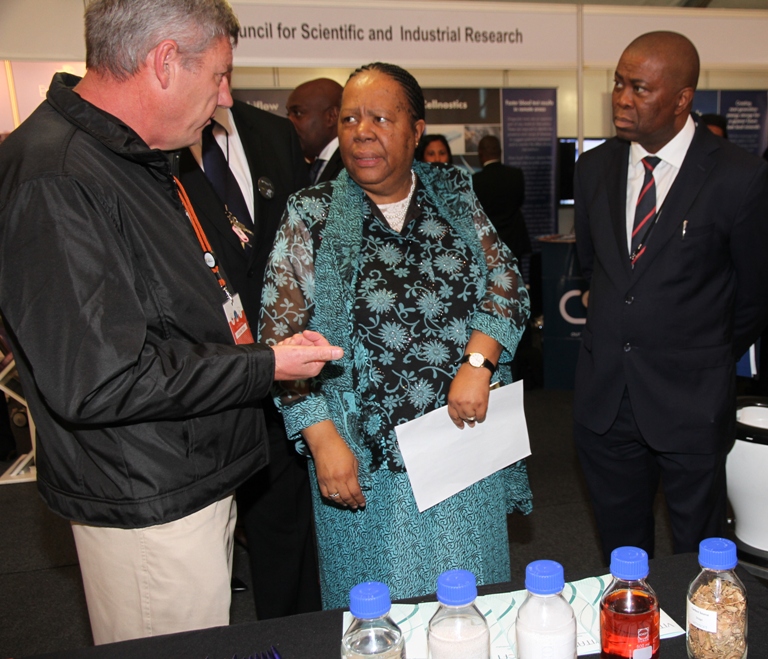
Minister Naledi Pandor and Director-General Phil Mjwara visting the exhibition before the Budget Vote speech
"Investment in research and innovation can and will lead to greater prosperity, more jobs and more entrepreneurs," asserted the Minister of Science and Technology during her Budget Vote speech in Parliament on 21 May.
The Minister said that, while the DST was working closely with National Treasury to map out a process for ensuring that South Africa's general expenditure on research and development reached the target of 1,5% of GDP by 2019, she remained "concerned that inadequate resources for research and innovation will deny us the opportunity to realise the full potential of the difference science and innovation can make in society."
For the 2015/16 financial year, the DST has been allocated R7,482 billion (up from R6,198billion in2013/14 and R6,480 billion in 2014/15), which will be divided between its Programmes as follows:
Of the R7,482 billion, 92,2% (R6,9 billion) will be allocated to entities that report to the Minister of Science and Technology. Parliamentary grants make up R2,534 billion of the 92,2%, which will be transferred as follows:
Key priorities for the DST over the medium term include developing human capital, creating new knowledge, growing research infrastructure, and encouraging innovation by funding marketable products emerging from research and incubation.
Several programmes in these priority areas have already produced results that respond to the country's triple challenges of unemployment, inequality and poverty. Some of the beneficiaries of the programmes were invited to attend the Budget Vote speech, and were introduced to Parliament by the Minister.
Whiskey Kgabo and Suzan Malangana, who supply mangoes to Wolkberg Fruit Processors (which started as the Nkowankowa Demonstration Centre pilot in Limpopo), wrote the Minister a letter to thank the government for supporting the centre. Ms Malangana told the Minister that the centre had enabled her to build a house and pay school fees.
The centre supports small backyard mango producers in the Tzaneen area to supply mangoes, at fair-trade prices, that can then be used to produce higher-value products such as dried fruit and juice. Links have been established with the University of Limpopo, which provides agricultural support services that help to increase yields and the quality of mangoes.
The Department will be using the experience gained with the centre to feed into the broader government programme aimed at establishing agroprocessing hubs.
Another project showcased during the Budget Vote was the Iluba project. Jacobus Viljoen, Thululeni Dube, Tshifhiwa Maano and Stephanus Viljoen, who run Iluba, also attended the speech. The project uses an environmentally friendly treatment process developed by Nelson Mandela Metropolitan University that allows roses to look and feel fresh for months. The flowers are now exported to Europe, the Far East, the Middle East and North America. The project generates an annual turnover of over R10 million and employs more than 75 people.
Other guests invited by the Minister included the mLab team who developed a mobile application, #We Are Africa, for an online anti-xenophobia campaign. The Minister said that the team, consisting of young people from Angola, South Africa and the Democratic Republic of Congo, had shown that science and technology could help to solve social as well as economic challenges.
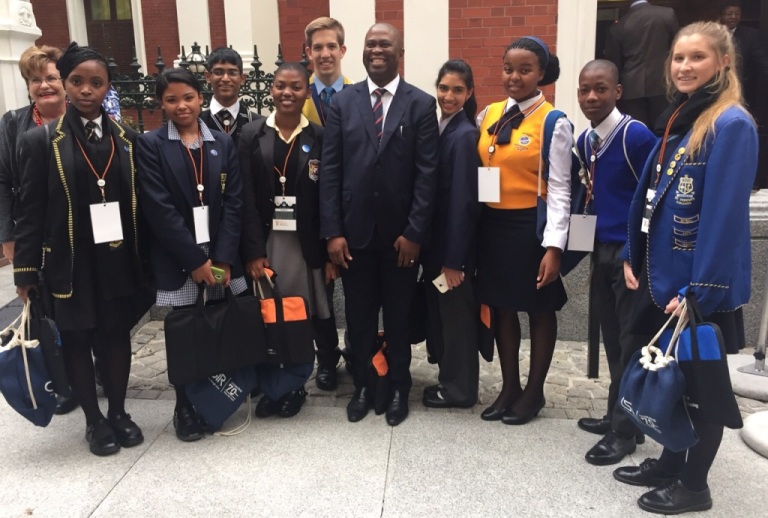
Nine of the brightest young scientists in the country were also in attendance. They were winners at last year's Eskom Expo for Young Scientists, and they will be representing South Africa at international science events in London and Belgium in July this year.
The Minister urged young people at school, college and university to study mathematics, science and technology so that they could play a full role in creating a better Africa and a better world.