
REMARKS BY THE DEPUTY MINISTER OF SCIENCE, TECHNOLOGY AND INNOVATION, ON THE LAUNCH OF THE IRIS AI HUMANOID ROBOT SHOWROOM AND MANUFACTURING PLANT AT DUBE TRADE PORT | THURSDAY, 13 AUGUST 2026
Founder and CEO of BSG Technologies, Ms Thando
The Dube Trade Port Executives and Representatives.
The Senior Officials of the Provincial Government.
A key stakeholder, KZN Department of Education.
Amakhosi.
Ladies and gentlemen.
Allow me to congratulate BSG Technologies, founded and led by a young woman, Ms Thando, for developing one of the most promising technological responses to a pressing challenge in our education system. The innovation of the IRIS AI Humanoid Tutor is a milestone that South Africa must appreciate, support and scale. It represents the kind of practical innovation that moves technology from the laboratory into the classroom, and from abstract possibility into direct service of society.
One of our greatest challenges remains the shortage of specialized teaching resources, particularly in mathematics, science, coding and other critical subjects that prepare young people for the modern economy. This challenge is felt most sharply in rural and under-resourced schools, where the quality of teaching and learning is often constrained by geography, infrastructure, poverty and unequal access to specialized educators.
IRIS does not replace the teacher. Rather, it can support the teacher; reinforce lessons; provide additional explanations to learners; assist with revision; help identify learning gaps; and offer personalized support where a learner may need more time, more practice or a different explanation. In that sense, this innovation responds directly to the societal problem of unequal access to quality education.
Technology and AI as Solutions to Societal Problems
As the Department of Science, Technology and Innovation, our mandate is to support science, technology and innovation that address the real conditions of our people. Technology must not be treated as a luxury available only to those who can avoid it. It must be understood as a developmental instrument: a tool to improve education, strengthen healthcare, expand access to public services, create jobs, support small businesses, modernize agriculture, improve safety, and help communities solve practical problems.
Artificial intelligence, robotics, data analytics and digital platforms are already reshaping the world. The question before us is not whether South Africa should participate in this technological transformation. The real question is whether we will be passive consumers of imported technologies, or active producers of technologies designed around our own social realities. Our responsibility is to ensure that technology is used to reduce inequality rather than deepen it; to broaden access rather than exclude; and to empower teachers, learners, workers, entrepreneurs and communities.
In education, AI can assist in diagnosing learning gaps, providing adaptive learning support, translating complex concepts into simpler language, helping teachers prepare lessons, supporting assessment, and giving learners additional opportunities to practice. Technology must be judged not by how advanced it appears, but by how effectively it improves people's lives.
However, we must invest in infrastructure, connectivity, teacher training, digital skills, data protection, local languages, ethical safeguards and inclusive design. AI must serve human development. It must enhance human agency, not remove it. It must support teachers, not undermine them. It must help learners think, reason and create, not merely consume information. Above all, it must be introduced in ways that protect dignity, promote equity and build public trust.
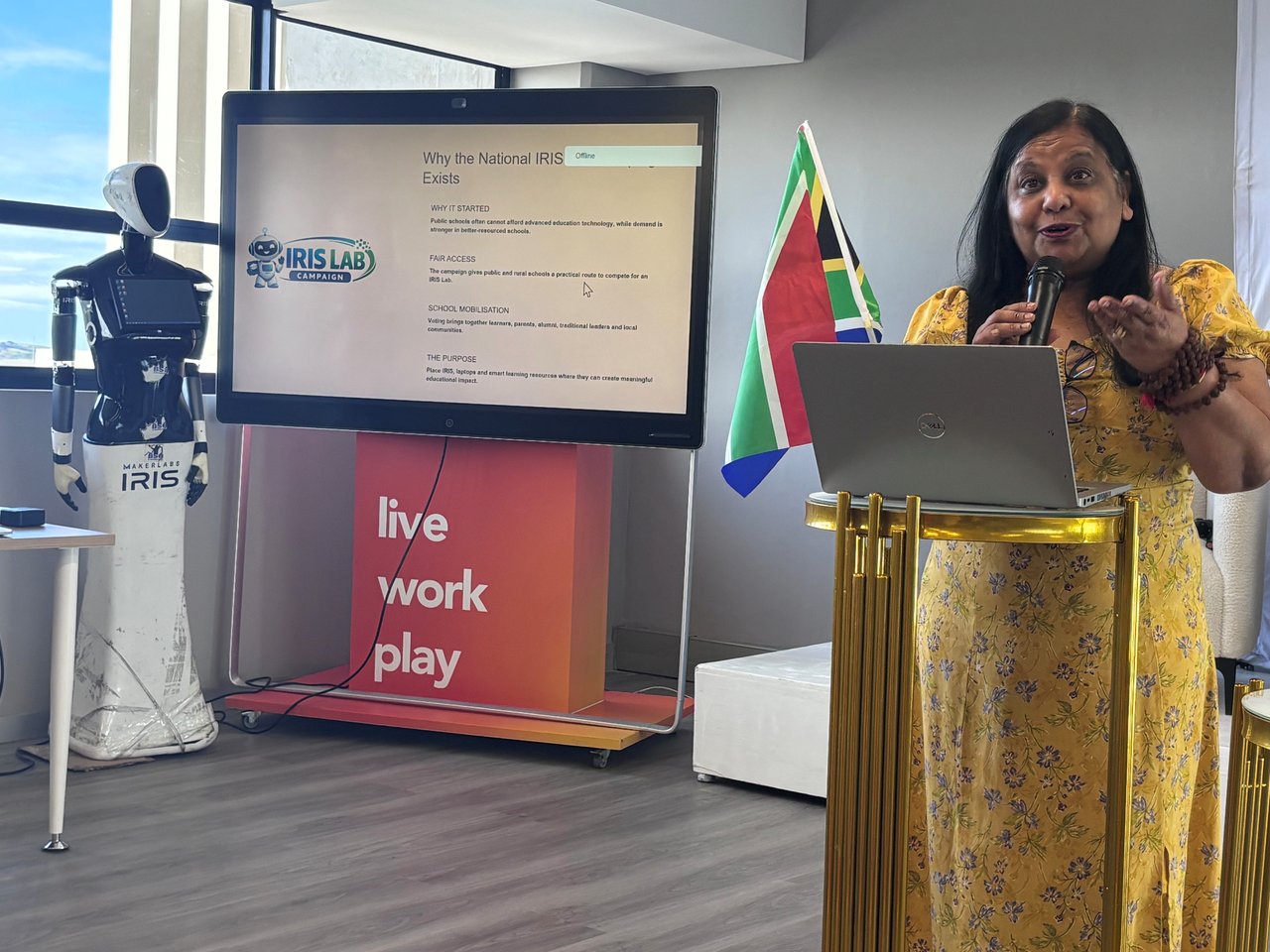
This is why today's official launch of the IRIS Showroom is so important. I had the privilege of launching the IRIS Humanoid last year in Durban, and I am pleased that the work has proceeded with purpose and momentum. The IRIS Showroom has been established as an innovation space where schools, stakeholders, government departments, investors, organizations, parents and the broader community can experience how artificial intelligence and robotics can contribute to education, learning support, skills development and the advancement of Fourth Industrial Revolution technologies.
Capabilities of the IRIS AI Humanoid Tutor
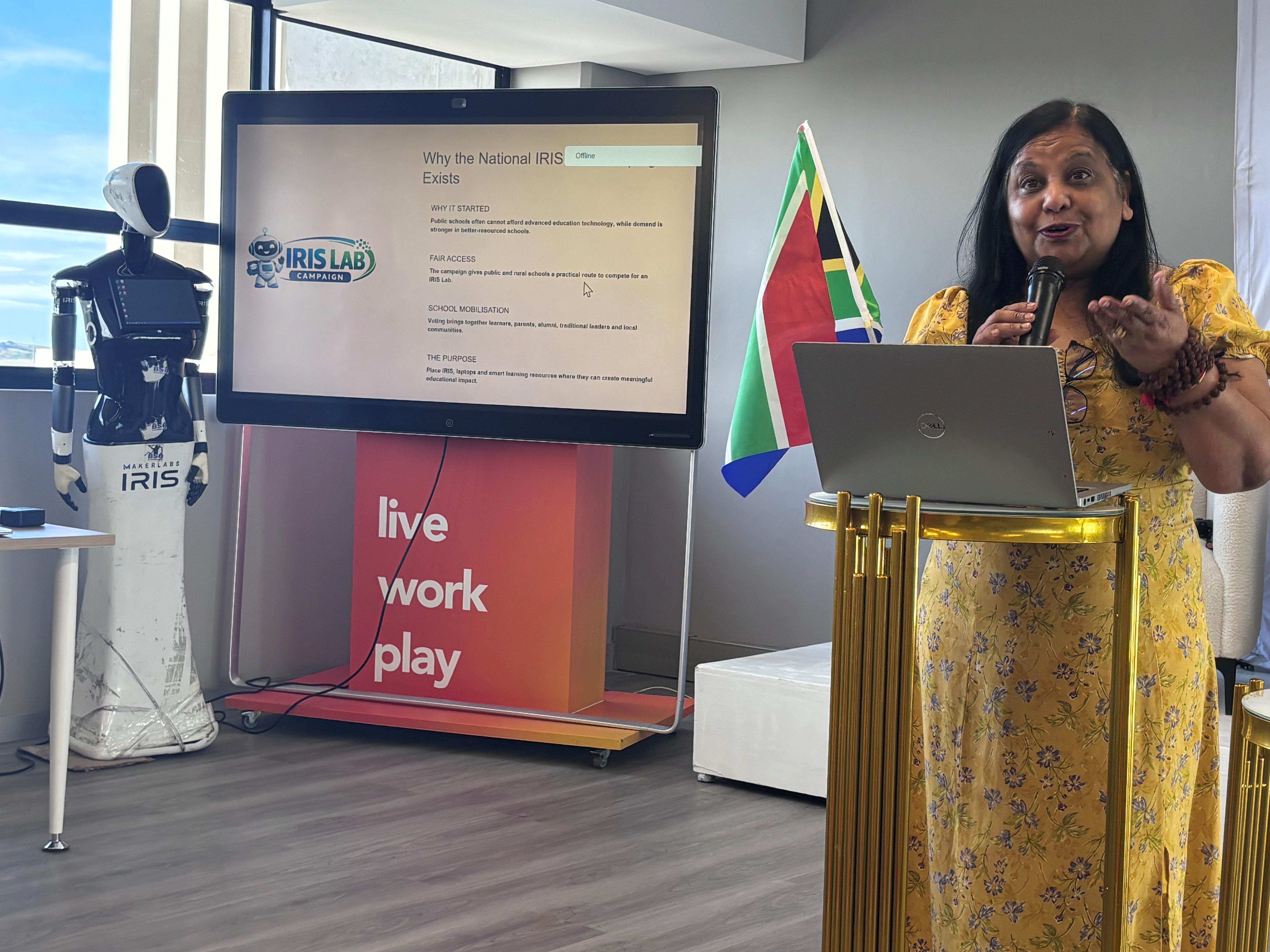
Today we are gathered to showcase the capabilities of this humanoid robot in the following areas:
- AI tutoring support for learners in different subjects;
- Interactive learning assistance through voice and smart engagement;
- Marking and learner performance analysis;
- Personalized learning support for learners who need additional academic assistance;
- Teacher support tools to assist with learning progress and classroom engagement;
- Learner performance tracking and reporting;
- Support for coding, robotics, artificial intelligence, and STEM education;
- School and parent support features to improve learner monitoring and academic development;
- Innovation demonstration for schools, organizations, and stakeholders.
Adoption, Scale and Local Industrialisation
I hope that the number of schools interested in adopting this technology as an aid to improve the quality of teaching and learning will grow in leaps and bounds. Adoption is the bridge between invention and impact. A technology that remains in a showroom cannot transform society. It must be tested, refined, localized, procured, deployed and supported in real learning environments.
Technologies of this nature may not always be affordable at the beginning because of the cost of research, design, engineering and production. However, as uptake grows, costs can come down, supply chains can mature, technical support can expand and local jobs can be created. For this reason, government, education authorities, investors and the private sector should work together to create pathways for adoption, especially in schools that need support the most.
I am also encouraged by the prospect that this humanoid will no longer be built entirely outside South Africa, and that this site can become part of a local manufacturing and innovation ecosystem. If the intellectual property, technical skills, maintenance capability and production capacity are increasingly located in South Africa, then investment in IRIS becomes more than the purchase of a device. It becomes an investment in local enterprise development, industrial capability, youth employment and technological sovereignty.
Technology Must Work With Teachers, Not Against Them
Another important point is that there should be no fear that the scaling of this technology within the education system will disrupt teaching or cause job losses. AI and other technologies are unavoidable, but they must be adopted in a manner that is human-centered, ethical and developmental. We must work side by side with these technologies rather than fear them. There will always be a need for the wisdom, care, judgement, discipline and leadership of a teacher. A machine may provide information, but a teacher forms character, interprets context, motivates learners, identifies social barriers and builds the human relationship that makes learning possible.
The task before us is therefore to prepare teachers and learners for a future in which technology is part of everyday life. That means teacher training, curriculum alignment, digital literacy, responsible use of AI, and continuous evaluation of whether these tools are improving learning outcomes. Technology must be a servant of education, not its master.
Conclusion
In closing, today's launch is not only about a robot. It is about the kind of country we are building: a country that believes its young innovators can solve national problems; a country that invests in science and technology for social good; a country that brings innovation closer to rural schools, township communities and ordinary households; and a country that refuses to be left behind in the technological transformation of the world.
Let us therefore support BSG Technologies, support the adoption of IRIS where it can make a meaningful contribution, and work together to ensure that artificial intelligence and robotics become instruments of inclusion, equality, learning and human progress.
Once again, congratulations with this achievement!
Thank you.
.jpg)