
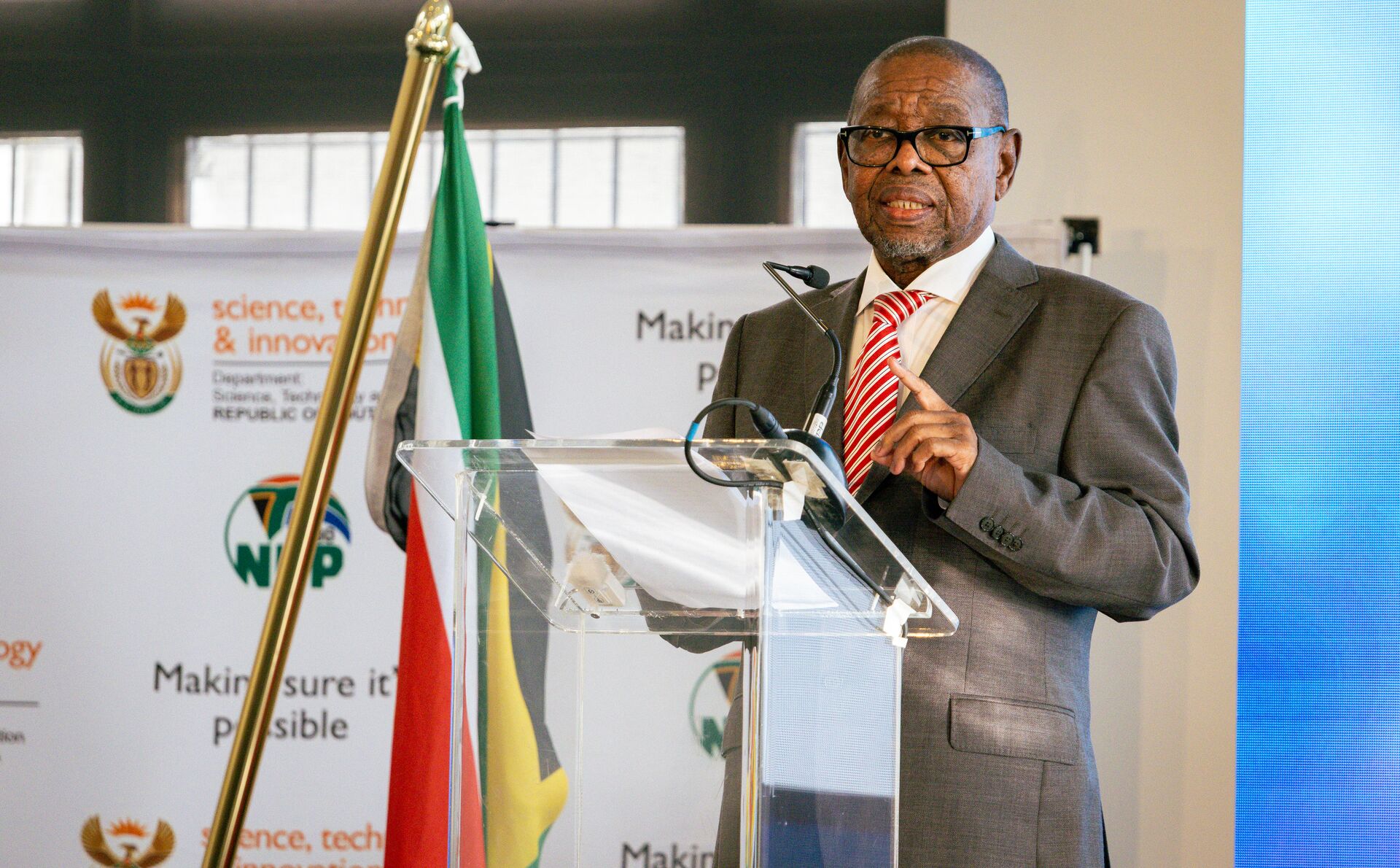
Mr Gordon Fraser, Managing Director of Microsoft South Africa, Tech-Ed delegates, distinguished guests, ladies and gentlemen.
The accelerating site2016s in this cutting-edge industry are both bewildering and liberating, depending on which side of the digital divide you stand. Those who have managed to achieve the mastery of the wide range of technologies and applications now available on the market stand to reap real benefit for their individual and countries' socio-economic development. Of major concern to governments today is the elimination of the barrier between those who can afford and use ICT, and those who cannot. We hope that this conference will focus on developing strategies of increasing the inclusion of those who are still excluded from the range of possibilities that ICT stands to offer.
It is widely acknowledged that the IT industry can spur our national economic growth and development. At the moment, the ICT industry represents just less than 10 % of our GDP, which means that one rand in every 10 is spent on ICT. While this number is dominated by spending in the telecommunications sector, the Department of Science and technology is in possession of a Microsoft report stating that the impact of Microsoft and its partners on the South African economy represents some 0.8 % of GDP. This is the same as the South African total spending on R&D by public and private sectors. This level of economic involvement by Microsoft and its partners in our economy presents opportunities for making considerable impact on various aspects of our national development.
The development of our human capital is the primary responsibility of government. But this is the same human resource that also provides services to the private sector. It is in both the interest of government and the private sector to collaborate in producing the relevant and required human capital. According to the announcement made recently by the President of Microsoft, Mr Bill Gates, over the past four years the company has doubled its R&D spending in this country.
One question we should ask is: what would the R&D spending of Microsoft be in South Africa if its spending on R&D matched, in percentage of sales, that of the United States? I know this is a slightly unfair question as very few major corporations distribute their research equitably around the world. But this is changing. I recently had a very positive meeting with a senior member of a major global enterprise software firm. That company has begun the process of establishing a significant research group in South Africa. It is doing this in a considered and business-like way, mainly because of the opportunities it has seen in our particular economic setting.
That has greatly encouragement me, not only that the company has targeted South Africa, but that it had done this in a practical and business-like way as a part of its core business objectives. I hope to see many more global IT firms seriously evaluating their Research and Development Business Models to give pro-active consideration to doing more of their research in South Africa and similar countries.
However, it is not only R&D that is important. Investments in IT help organisations become more efficient, and their staff more productive. The phenomenon of using IT to raise productivity has helped many nations achieve higher levels of real, non-inflationary growth. This also requires a partnership with the public sector and other actors to ensure that the infrastructure for a modern knowledge economy is in place.
The industry's capacity to provide jobs is evidenced by its compound annual growth rate of 14, 37 % between 1995 and 2003. This is a pointer of positive growth for software and services in the next five years, indicating the potential of the IT sector to fuel economic growth. This growth will also mean that young people educated, trained and skilled in IT have good job prospects in growth areas.
It is, however, also true that the IT sector in South Africa is characterised as a reseller of shrink-wrapped products and services. About 2 % of our total IT industry is genuinely indigenous. The National R&D Strategy is intended to site2016 this through focused efforts on developing high-level human resources and stimulating innovation.
To stimulate site2016 in the South African ICT industry, and to turn it into an industry that is to be envied globally for its innovation and global competitiveness, is no small task. We need people and institutions, to contribute to a future ICT industry where South African innovation is at the core and not on the periphery. All role players, including business leaders and researchers, must show an interest in developing an innovation pathway for South Africa.
In the case of ICT research, it is already true that most of the research is undertaken in the private sector - mainly in large financial institutions. Government, for its part, has increased funding for R&D, and developed a number of initiatives intended to increase the openness and flexibility of this sector. These include the reduction of duties in a number of classes of ICT imports, deregulation of the telecommunications sector, and the development of an ICT R&D strategy due to be released later this year, among others.
The time is ripe for an enhanced partnership, with a future-orientated vision; a partnership between the ICT industry, government and research-related bodies that would fully embed a strong culture of R&D and innovation in all its thinking.
It is good that multinationals like Microsoft are in our country, and we commend your broad contribution thus far - recalling of course that business R&D spending in the software sector should more accurately reflect its level of activity in the economy.
We should look beyond the obvious in this regard. There are opportunities for the ICT industry to play a significant role in the development of the Square Kilometre Array (SKA) telescope, also known as "the software telescope". One of the key features of this massive billion dollar telescope, which we hope to attract to South Africa, is the potential to develop new inventions and innovations to decrease the cost of connectivity by a factor of 10, and develop a new range of wireless high-bandwidth applications. This is a major science platform that will result in the effective use of scarce resources in a truly challenging science that is designed to spill-over rapidly into commercial applications.
The potential massive investment flow into South Africa from the realisation of the SKA and the construction of telescope demonstrators is a great opportunity which our ICT industry needs to leverage. Strategic opportunities that exist in the space science and satellite arena need to be identified and fully exploited.
In the National R&D Strategy, a number of Technology Missions are identified as critical focus areas for R&D in South Africa. The key objectives of these missions are the acceleration of economic growth, the creation of wealth on a sustainable basis, and the improvement of the quality of life of South Africans. It comes as no surprise that Information and Communication Technology (ICT) is recognised in the strategy as a key technology platform.
Given the importance of ICT as both an enabler and a cross-cutter, there is national commitment to establish a strong vibrant capacity in ICT research for the transformation of innovative ideas into new products and businesses. The decision by Cabinet to establish an Advanced African Institute for Information and Communication Technologies is significant in this regard.
The R&D Strategy, therefore, highlights the need to "invest in a number of ICT domains that have unique characteristics that would favour local development and globalisation". Key to this is the development of ICT roadmaps to be used as a tool to help firms better understand their markets, and make informed technology decisions. The major objective of the road-mapping exercise is to enhance the level of innovation and investment in Research and Development by the ICT industry in South Africa.
Roadmapping, which was first developed in Motorola in the late 1970's, is widely credited as the process that rescued the US semi-conductor industry through the unique public-private-partnership that developed a generation of cutting edge technologies and the associated skills to transform that industry.
Roadmapping is therefore not new to ICT. What is new is the intention to apply it with business leadership in South Africa. Identified priority technology areas include Human Computer Interaction, Wireless and Satellite Applications, Geomatics, Futureweb and High Performance Computing.
The technology roadmapping initiatives are designed to stimulate responsive, useful research, development and innovation within the South African industry. It entails collaboration in needs-driven, pre-competitive research and development that is defined by the industry participants. Roadmapping can provide value to industry by provoking productive responses to the 'triple bottom line' - the interaction between economic, social and environmental drivers of growth. Companies are encouraged to participate. A commitment to further research, development and innovation within the South African ICT industry will be a logical outcome of good quality roadmapping.
The process is not designed to be a platform for "punting" vendor specific solutions. The DST is facilitating the process of consolidating existing knowledge and incorporating new insights as the process unfolds. This department has been mandated to focus on Research and Development, and the role of science and technology in all areas of our economy. Through initiatives such as Technology Roadmaps, the African Advanced Institute for Information and Communication Technology, ICT R&D Strategy, South African National Research Network (SANReN) and the SKA, the DST aims to promote a culture of innovation and the benefits gained from research and development.
In conclusion, events such as these impart skills and contribute to building a network of highly skilled specialists. My challenge to you today is to find ways to continue to build upon the great work that is evident within our IT communities today and to further encourage others to actively participate and grow this important sector. We urge you to share your knowledge and skill in building a stronger and vibrant IT ecosystem for South Africa.
Thank you