
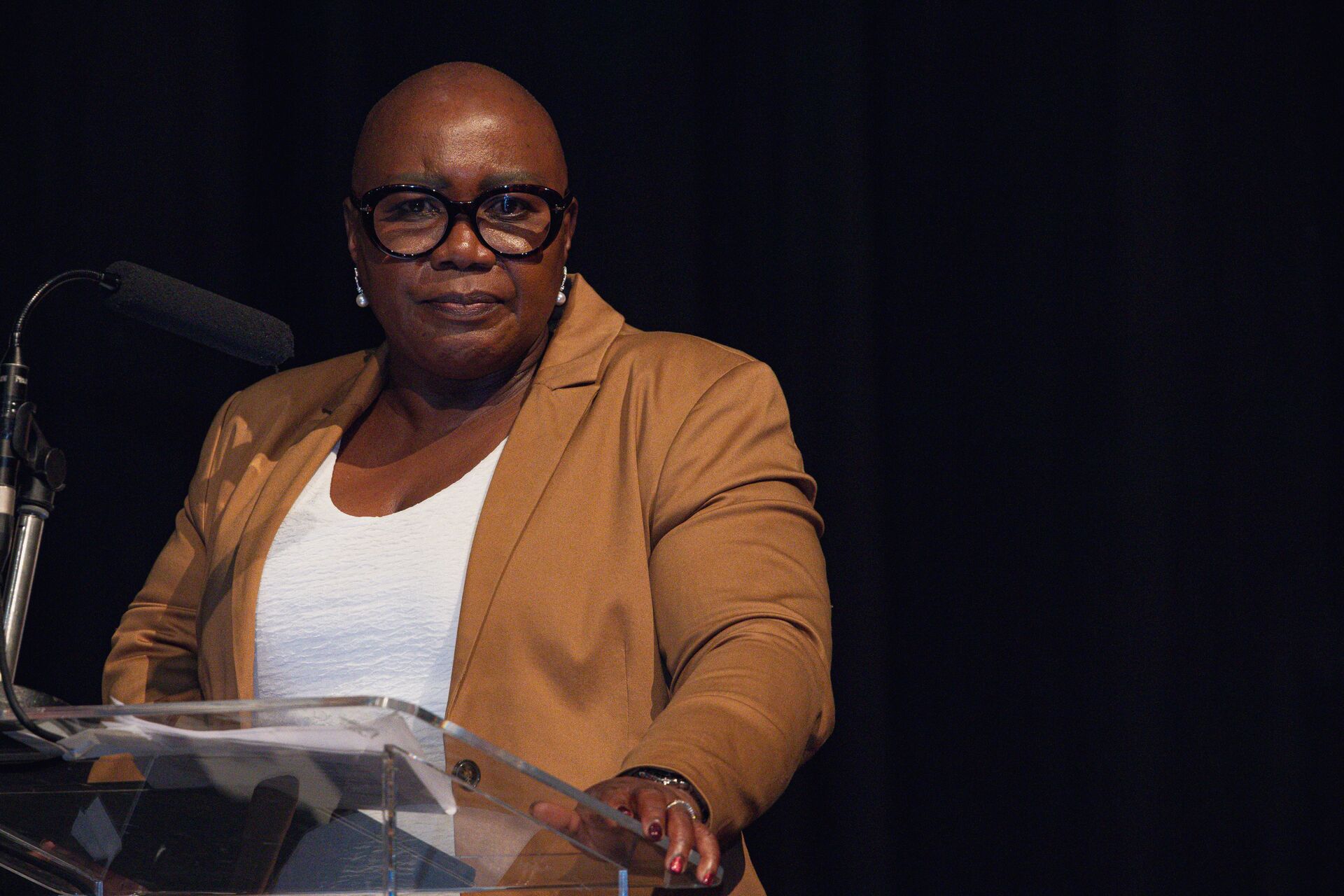
Founder and leader of Amandla Omnotho, Mr Gugulethu Xaba.
Honoured guests and speakers today:
MEC for Cooperative Governance and Traditional Affairs in KwaZulu-Natal, Rev. Thulasizwe Buthelezi.
University of Johannesburg Professor, Prof. Siphamandla Zondi.
USA, MIT Professor, Dr. Irshad Ahmed.
DTIC Chief Director, Thami Klaasen.
KZN Oils, Ms. Reddy.
Connect Energy Launch, Mr Sibonelo Mbatha.
Our SMMEs and Farmers,
Ladies and gentlemen.
It is an honour to speak on a subject that goes to the heart of South Africa’s future: rural areas as engines of economic growth, and the role of innovation in unlocking that growth. Let me congratulate Mr Gugulethu Xaba for building this platform in a decade now, and now celebrating its 10th anniversary this year.
I want to begin with a provocation: the next great South African economic breakthrough will not come from a skyscraper in Sandton. It will not emerge from a glass-and-steel innovation campus in Cape Town's tech quarter. But it will come from the soil, or should I say, from the agricultural sector. With all the disruptions happening in various industries and in our lives, one thing that cannot change is the fact that, as a people, we must eat. So, the food market, especially in Africa, is growing rather than shrinking because we are a growing population.
In speaking about the agricultural economy, we must not fix ourselves only to large-scale commercial farmers and agro-processors dominating our retail food markets. But I refer to a rural village women's cooperative meeting held under a tree, processing chilies at five o’clock in the morning, already supplying three provinces. I am referring to small-scale rural farmers combining their produce to establish a farmers’ market centrally for different villages to sell vegetables, milk, meat, eggs, including live chickens and goats; a logistics value chain through bakkies and trucks becomes part of this economy.
Amandla Omnotho has given this rural economic ecosystem a name: Ruranomics.
Ruranomics should not be a slogan. It must be treated as a framework. It is a declaration that the rural economy is not a charity case — it is an asset class. And today, as the Ministry of Science, Technology and Innovation, we are here to say with full conviction: science belongs to our rural communities, and the rural areas belong to the economy. Our Decadal Plan is bold in calling for the Department of Science, Technology and Innovation to solve grand societal challenges and to locate ourselves at the centre of government, education, industry and society.
Rural South Africa does not need to be saved. It needs to be connected — to capital, to markets, to technology, and to the policy courage that matches its people's ambition.
For too long, rural areas have often been described and viewed mainly through the language and lens of need, poverty, under-development and dependence: need for infrastructure, need for jobs, need for services, and need for investment. There is no doubt that such are not mere perceptions; they are lived realities of our rural areas, and as we acknowledge them, we must indeed put ambitious programmes to address them.
South Africa's rural areas are home to approximately 17 million people — nearly a third of our population. They sit on land that feeds the nation, raises its livestock, and holds its mineral and ecological inheritance. Yet their contribution to formal GDP remains stubbornly marginalized.
Why? Not because the potential is absent. The architecture of economic inclusion has never been fully extended to rural communities. The roads, the broadband, the cold chains, the finance instruments, the processing facilities — these were built for, and around, large commercial interests. The emerging and smallholder farmer, the rural SMME, the village- level innovator — they were expected to somehow plug into a system that was never designed with them in mind.
Today, however, I want us to shift the frame and give a whole new narrative of rural areas. Rural South Africa is not only a place of need. It is also a place of opportunity, capacity, possibility, hope, production, culture, natural resources, and entrepreneurship. If we agree that South Africa's natural resources, agricultural assets, biodiversity, mineral wealth, and cultural heritage are located in rural areas, we can indeed also agree that the foundations of our future economy lie largely in rural communities.
If we want inclusive growth, we cannot build it only from our cities and metros. We must build it from our villages, farms, small towns, mining communities, coastal settlements, and inland corridors.
The question before us is not whether rural areas can contribute to economic growth, but how innovation can help transform rural areas from sites of extraction into centres of production, value creation, entrepreneurship, and prosperity.
DSTI support to Agriculture and Agro-processing
We have a Unit called Agricultural Biotechnology responsible for agricultural technology development support and skills development for the sector through a Master's to PhD programme. These programmes are under the Agriculture Bio-economy Innovation Partnership Programme (ABIPP). ABIPP outputs include new bio-innovations (products, prototypes, and services), more farmers becoming commercialized, including farmer development support, increased nutrition security, skills development, as well as precision agriculture and digital capabilities to modernise the sector and deliver innovations. This instrument recorded the completion of seven technology prototypes, 28 products launched, four agro-processing products demonstrated, and one digital agriculture app demonstrated. Several of the launched products were also handed over to SMMEs, with a total of 16 SMMEs supported during this financial year.
Another prototype, a mobile kitchen unit, was successfully developed and tested through the Promoting Agro-Processing in Low-income Communities project. Ten fully equipped mobile kitchen carts were produced and distributed to women entrepreneurs in Limpopo, Mpumalanga, and North-West provinces to support small-scale food enterprises.
Agriculture remains the backbone of many rural economies. It is a source of food security, employment, exports, and livelihoods for millions of South Africans.
However, agriculture today is undergoing a profound transformation. The farms of the future will not only depend on land availability, water, and labour; they will increasingly depend on knowledge, technology, and innovation. It is for this reason that, as a Department, our decadal plan makes a clear commitment to have as one of its focus and pillars, the modernisation of Agriculture.
Precision agriculture, satellite imagery, drones, artificial intelligence, climate- smart farming techniques, biotechnology and digital advisory services are
enabling farmers to produce more with fewer resources while improving resilience to climate change. This is our main focus as a Department that innovates new technology solutions.
Renewable energy solutions can now power irrigation systems and agro- processing facilities. In our grassroots innovation programmes, we are seeing all these becoming a reality, especially empowering young people to re-ignite the appetite for farming. This, at a time when the average age of a farmer is a matter of concern, is estimated to be between 57 and 62 years. The role of technology in lowering the average age of a farmer and ensuring future food security is undisputed. Our precision farming demonstrator and digitisation through livestock tracking technology have proven that a farm armed with sensors to predict all sorts of crop stress, or track livestock to curb stock theft and loss, will indeed become the norm.
South Africa's rural areas are also home to significant mineral resources that support our economy, from platinum, coal, iron ore, manganese, etc., in the North West, Northern Cape, Mpumalanga and Limpopo provinces. These provinces bear a notorious nametag – they are referred to as poor provinces.
Yet history teaches us that mining alone does not automatically create sustainable local development. Communities often witness the extraction of wealth without experiencing its benefits.
Logistics: Connecting Rural Economies to Markets
One of the greatest barriers facing rural development is inadequate logistics infrastructure. Roads, railways, storage facilities, digital connectivity, ports, and logistics hubs are the arteries through which economic growth flows.
Innovation is transforming logistics globally. Digital platforms, smart supply chains, data analytics, automated tracking systems, and integrated transport networks are reducing costs and improving efficiency.
For rural South Africa, modern logistics can connect farmers to consumers, miners to manufacturers, and tourism destinations to global visitors. Every kilometre of road improved, every broadband connection established, and every logistics hub developed strengthens the competitiveness of rural economies.
Infrastructure is no longer simply about movement; it is about enabling participation in a modern economy.
Tourism: Transforming Heritage and Nature into Economic
Opportunity
South Africa possesses some of the world's most remarkable natural landscapes, cultural heritage sites, biodiversity assets, and indigenous knowledge systems.
Many of these treasures are found in rural areas.
Tourism represents one of the most inclusive sectors for economic growth because it creates opportunities across multiple industries, including hospitality, transport, agriculture, arts and crafts, cultural enterprises, and small businesses. In this province, KwaZulu-Natal, I often lament how we don’t exploit rural tourism and generate jobs for ourselves. Take the heritage route which runs from Ulundi all the way, eMakhosini, Babanango (esikhaleni kwaNtombela), eShowe, KwaDukuza (iLembe), eThekwini.
Using this Zulu heritage route with each area under Amakhosi, focusing on the historic niche for tourists and traditional huts for accommodating guests, working with KZN Tourism. Tourism must not mean Durban and the beach, but the Zulu nation as well.
Innovation can help rural tourism destinations reach global audiences through digital platforms, virtual marketing, smart booking systems, and immersive visitor experiences.
Community-based tourism models can ensure that economic benefits remain within local communities while preserving cultural heritage and environmental sustainability.
The future tourist is seeking authentic experiences. Rural South Africa offers exactly that — if we invest in innovation, infrastructure, and entrepreneurship.
The department has a unit called Indigenous Knowledge Systems (IKS). We are profiling our indigenous knowledge, recording it and developing IPs for it so that other nations do not steal it. We also protect communities with their own indigenous knowledge attached to them through IPs, so that anyone using it commercially must pay these communities. In this programme, we work with traditional healers on profiling imithi and their healing capabilities, the trees and roots used that must be kept and recorded from research work. Part of this work has been a higher education programme developed for traditional healers in universities to study and get degrees. We have developed these courses offered at the University of Venda, the University of KwaZulu-Natal and the University of North West. Already, we have a first cohort that graduated last year. The indigenous knowledge that our elders had on weather patterns, climate in general, livestock management, crop ploughing systems and others, which were scientific but not in the western scientific sense, we want to record them and reproduce them so that we keep the wisdom alive.
We are building smart rural villages, piloting one in Nyandeni in the Eastern Cape, working with the local municipality. We intend to build the second Smart Village in KZN, after the Zulu royal approached the Department about building a second Smart Village in KwaNobamba, Nongoma municipality. We invite Amandla Omnotho to come closer and work with us on this IKS programme.
Building Innovation Ecosystems in Rural Areas
Our universities, science councils, development agencies, and private sector partners have a critical role to play in ensuring that innovation reaches every corner of our country. It is for this reason that both our entities, the Technology Innovation Agency, the CSIR, the National Research Foundation and the South Africa National Space Agency, as well as agencies of sister departments such as the Agricultural Research Council, the Council for Geoscience and Mintek, are hosting a range of DSTI-funded initiatives in Agriculture, Mining and Manufacturing.
Innovation is a catalyst for businesses and the economy. It must not be confined to urban centres. It must become a tool for rural transformation. This is why we shall forever invest in Innovation for Inclusive development, where inclusivity encompasses the youth, women, people living with disabilities and as an aspect of what we call spatial transformation, the reach to rural communities.
Conclusion
As we look to the future, we must reject the notion that rural areas are peripheral to economic development.
Rural areas are not the margins of our economy; they are its untapped frontier. They produce our food. They host our mineral wealth. They preserve our biodiversity. They protect our cultural heritage. They hold immense entrepreneurial potential. With innovation as our catalyst, agriculture can become smarter, agro-processing more competitive, mining more inclusive, logistics more efficient, and tourism more impactful.
The future of South Africa's economic growth will be built wherever innovation meets opportunity, wherever talent meets investment, and wherever communities are empowered to create value from their own resources. Let us therefore commit ourselves to building rural economies that are innovative, inclusive, sustainable, and globally competitive.
In doing so, we will not only unlock economic growth but also create dignity, opportunity, and prosperity for generations to come.
Thank you.
.jpg)