
President of the IAU, Professor Debra Elmegreen, and members of the IAU Executive Committee;
President of the African Astronomical Society (AfAS), Prof Thebe Medupe;
NRF Board Chair and Vice Chancellor of the University of Cape Town, Prof Mosa Moshabela; and the NRF CEO, Dr Fulufhelo Nelwamondo; our host organization;
Leaders of the South African National System of Innovation and Higher Education
The Director-General of the SKA Observatory , Prof Phil Diamond;
Members of the diplomatic core;
Members of the Media;
Distinguished guests;
Ladies and gentlemen:
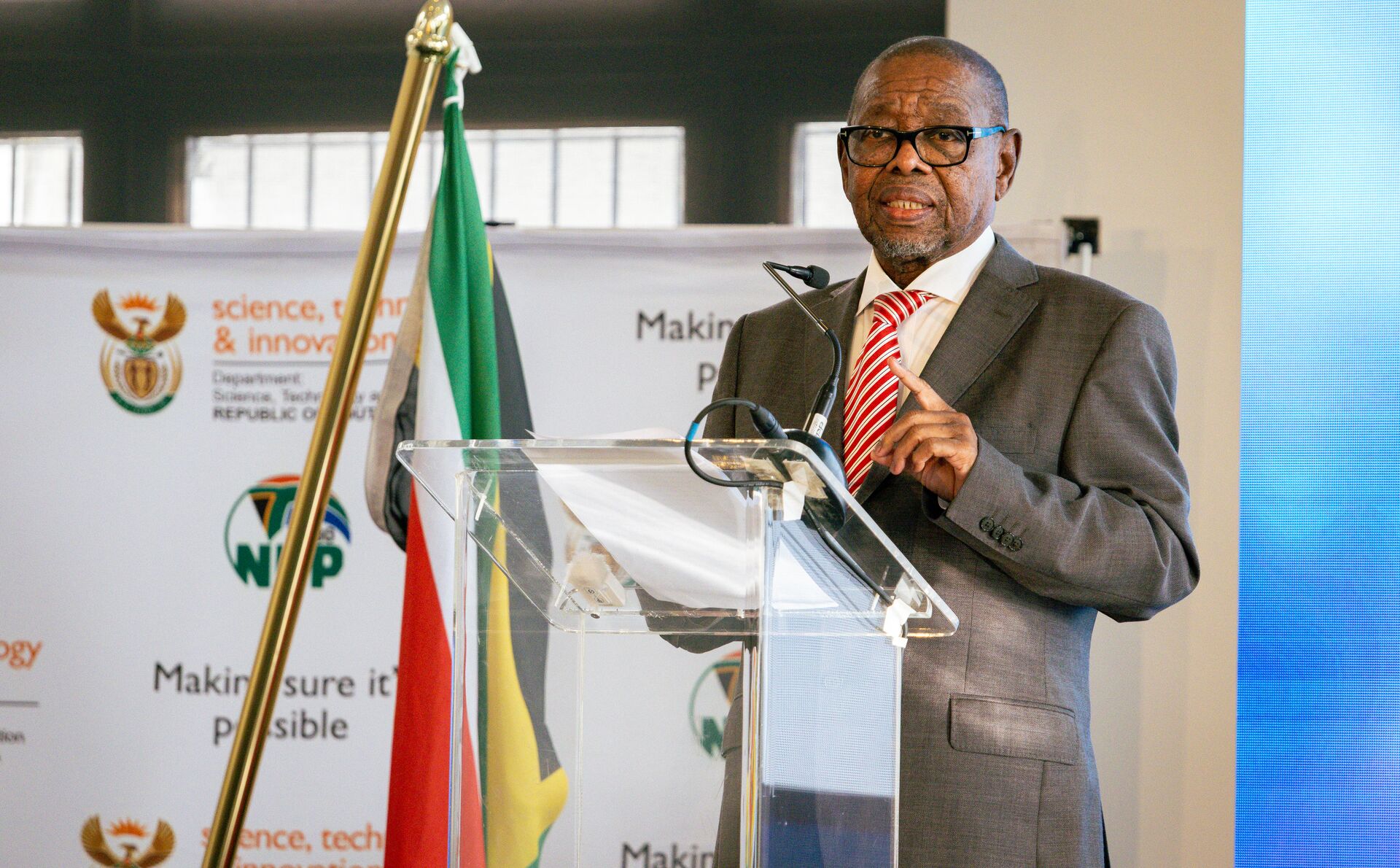
It is my honour and privilege to deliver this keynote address to this prestigious occasion-the International Astronomical Union General Assembly, which as I understand it, is the world’s largest body bringing astronomical science across the planet together.
This year’s Assembly is particularly special to us as a country as it is the first to be hosted on the African continent. Our slogan from the time we first proposed this event to be held here, has been “It’s Time for Africa, Ke Nako” and it is hoped the Conference will showcase the current contribution of African astronomy to global astronomy and its future development.
The hosting of this first-ever IAU General Assembly on African soil is a great privilege not only for our country but the entire continent.
On behalf of our president, Mr. Cyril Ramaphosa and the people of our country, I wish to extend a special South African welcome to all the IAU delegates to South Africa.
It is perhaps also fitting at this moment to remind ourselves of the continuities across ancient and modern timescales of African astronomy that predates contact of its indigenous communities with Europeans, and which spawned indigenous knowledge in mathematics, physics, and astronomy.
Of course, these advances in early African knowledge of celestial systems and forces were closely tied to the survival and evolutionary history of those Africans. For example, the nomadic peoples carefully studied astronomy in order to guide their travel across the desert regions.
As part of the controlling the Nile valley and agricultural cycles, the ancient Egyptians studied the skies to predict the world’s first 12-month, 365-day calendar.
The Dogon people of Mali had sophisticated knowledge of the orbits of the Sirius stars. Their astronomer priests held ceremonies to celebrate the return of these stars every sixty years.
During the 14th century, in Timbuktu (also Mali), astronomy was a taught as a specialised subject. Scholars came from many parts of the ancient world to study in Timbuktu.
Africa is also home to some of the world’s oldest technological achievements. The 7,000-year-old stone circle known as Nabta Playa in Egypt the observations of the skies have been part of our heritage from time immemorial, as our ancestors recognised the ways that the stars and the moon mark significant seasonal events.
Inspired by this history, indigenous astronomy continues to be a major part of our astronomy programmes and it is therefore pleasing that this Conference will showcase the Cosmic Echoes, a Shared Sky Indigenous Art exhibition.
The story of the evolution of modern astronomy in South Africa is an equally fascinating one. Astronomy was institutionalised in South Africa just over two hundred years ago with the establishment of the Royal Observatory on the grounds of what is today known as the South African Astronomical Observatory (SAAO) in Cape Town which is responsible for optical and infrared astronomy.
Radio astronomy began in South Africa with a 26-metre dish built by NASA and placed in Hartebeeshoek in 1961 as a ground deep station used to get data from, and send commands to, many unmanned US space probes going beyond Earth orbit.
This dish was later converted into a radio telescope that led to the establishment of the 26m Hartebeesthoek Radio Astronomical Observatory (HartRAO), which is now part of the South African Radio Astronomy (SARAO).
But it was really with the advent of democracy in 1994 that South African astronomy experienced major leaps on a number of fronts.
During the democratic era, two major international telescopes were set up in South Africa, which include 10-metre Southern African Large Telescope (SALT) in Sutherland, the largest optical telescope in the Southern Hemisphere.
Then there is the MeerKAT telescope in Carnarvon, which is a precursor to the SKA project. The MeerKAT is another amazing achievement on the global science stage, and we wish to thank our international partners, Germany, Italy, and China for their contribution to this project.
We are also having a growing gamma-ray astronomy community that actively participates in the High-Energy Stereoscopic (HESS) telescope that is located in Namibia.
All these strategic interventions have enabled South Africa to exponentially increase the number of astronomers from 60 (only 5 of them were radio astronomers) to about 300 in the last 30 years.
This year we are launching a new Presidential PhD programme which aims to send successive cohorts of students abroad to pursue full-time and split-side PhD studies in reputable, world-class knowledge and innovation institutions targeted at developing critical skills in areas like artificial intelligence research, advanced biotechnology, fuel cell development, batteries and other storage, and next-generation mining.
I hope that astronomy and space science will benefit from this initiative given the truly internationalist and multi-disciplinary nature of these fields.
Ladies and gentlemen, our vision is for South African astronomy to become a global hub for astronomical sciences and facilities as articulated in our National Strategy for Multiwavelength Astronomy of 2015.
The strategy provides a framework to take maximum advantage of South Africa’s historical strengths in astronomy, its geographical advantage of clear southern skies in the Karoo, the engineering and scientific base, large-scale investments in the MeerKAT/SKA endeavour and SALT, and South Africa’s growing international ranking and partnerships in astronomy.
This strategy is currently under review in consultation with the astronomy community so that it can be enhanced in order to take advantage of new opportunities in this era of multi-messenger techniques and technological innovations.
The MeerKAT/SKA project, in particular, offers us an opportunity to contribute to the knowledge economy and the big data revolution through international collaborations and the pursuit of world-class research, thereby driving transformation and human capacity development. The SKA is the flagship frontier science partnership of the 21st century and South African remains fully committed to it. I would like to congratulate Prof Diamond on the outstanding progress being made in progressing construction.
It is certainly a key commitment of the 7th administration to ensure that we empower our continent with high-speed research networks, computational technology, and cloud infrastructures as part of preparing Africa for the challenges and opportunities of 21st century astronomy.
If we are to promote and secure citizen support for astronomy, it is of course our duty to link its value and purposes to the lives of local people’s. Firstly, we have a duty to explain the link between cosmic origins and the human story.
This requires us to broaden the base of science engagements across all parts of society, particularly the most marginalised communities. The DSI is heavily invested in taking science to the people.
Secondly, for the social legitimacy and sustainability of African astronomy, we recognise how crucial human development is to ensure next generation of technical, engineering, basic and applied scientific skills underpin expansion of our infrastructure.
I wish to record my special thanks to both SAAO and SARAO and their sites in Sutherland and Carnarvon in their remarkable work supporting the training of technicians, telescope operators, astronomers, engineers, data scientists and administration professionals.
I am very pleased that the DSI is working closely with the Department of Tourism, led by my colleague, Ms Patricia de Lille, our Minister of Tourism, in developing the astro-tourism sector through community-public-private partnerships in remote parts of South Africa.
We are looking forward to the approval of our newly established Astro-Tourism Strategy by Cabinet in the next few months. Minister de Lille and I will soon be co-hosting the Annual World Tourism Day in Carnarvon on 27 September 2024 – and this event will provide us with a unique opportunity to promote the preservation of dark skies and radio silence in the Karoo as this is essential for star-gazing and astrotourism to thrive and to create jobs.
I always make the point that, given our history of racial discrimination and under-development, it is important that we demystify science and its purposes and meaning to the lives of all people, especially the most marginalised. This is especially important for black youth and women.
Astronomy offers such an amazing opportunity to naturalise and indigenise scientific thinking within all our communities. Therefore, it is most fitting that this event will have Open Access features online, to generate scientific interest from the wider public.
Young people have been appointed as volunteers for this event while others will be presenting their research posters, the GA satellite viewing sites across Africa and astronomy ambassadors programme that has been launched throughout the continent as one of the legacy projects post the General Assembly.
I am also delighted that in this month of August where we as a country celebrate women, that we have two African American women astronauts, Dr Sian Proctor, and Dr Mae Jemison, who will be giving public talks and engaging in outreach programmes with school learners.
There will be a dedicated programme on 9 August as part of this event as we commemorate Women’s Day by celebrating the remarkable contributions of women in science and astronomy.
The African Astronomical Society has a dedicated programme for women in astronomy through the African Network of Women in Astronomy (AfNWA). This year the International Astronomical Union Women in Astronomy (IAU WiA) will be holding a joint session with AfNWA at this General Assembly.
This session aims to facilitate discussions among astronomers on gender balance issues and policies supporting the careers of women researchers engaged in international mega projects located in Africa such as the SKA, SALT, HESS, AMT, etc.
Currently nine African countries are national members of the IAU. It is clearly in the interests of astronomy as a global scientific enterprise that we need to broaden the participation of the African continent in astronomical sciences.
I would also like to recognise the efforts made by the IAU Office for Astronomy Development (OAD) and the African Astronomical Society (AfAS), both based in Cape Town in supporting other African countries to take advantage of opportunities in astronomy.
We also see this Assembly as an opportunity for raising awareness of the IAU within the African science community and encouraging the emergence and professional development of the next generation African scientists.
The Organising Committee of the 2024 AG has also announced that over 3000 abstracts were submitted, which is an impressive number for such an event and certainly offers an opportunity to share new sources of data and evidence to test through experimental work the explanatory value of the theoretical models developed in recent years.
The abstracts cover a wide array of exciting topics based on the empirical results derived from new missions and surveys of different parts of the cosmos, including remarkable data coming from the MeerKAT Radio Telescope and James Webb Space Telescope.
In conclusion, I wish to thank the IAU for entrusting South Africa with hosting this prestigious gathering and all the teams, which contributed to the organisation. This gathering reflects the global astronomy community's commitment to advancing research, fostering collaboration, and addressing contemporary challenges in astronomy and those faced by humanity.
I wish you productive and exciting deliberations and look forward to the outcome of the 2024 International Astronomical Union General Assembly.