
Programme Director, Dr Nick Balkrishen, DHET Regional Manager;
Acting Premier, the MEC for Health in the North-West Province, Mr Madoda Sambatha;
Executive Mayor of the Ngaka Modiri Molema District Municipality, Cllr. Molefe Khumalo;
Mayor of the Tswaing Local Municipality, Cllr. Norah Mahlangu;
All Councillors present;
Traditional leadership;
Representatives from national, provincial, and local governments;
Heads of Organisations/Institutions
Chairpersons and Chief Executive Officers of all our entities;
Learners and educators;
Community members;
Members of the media;
Ladies and gentlemen
Dumelang
Sanibonani
Molweni
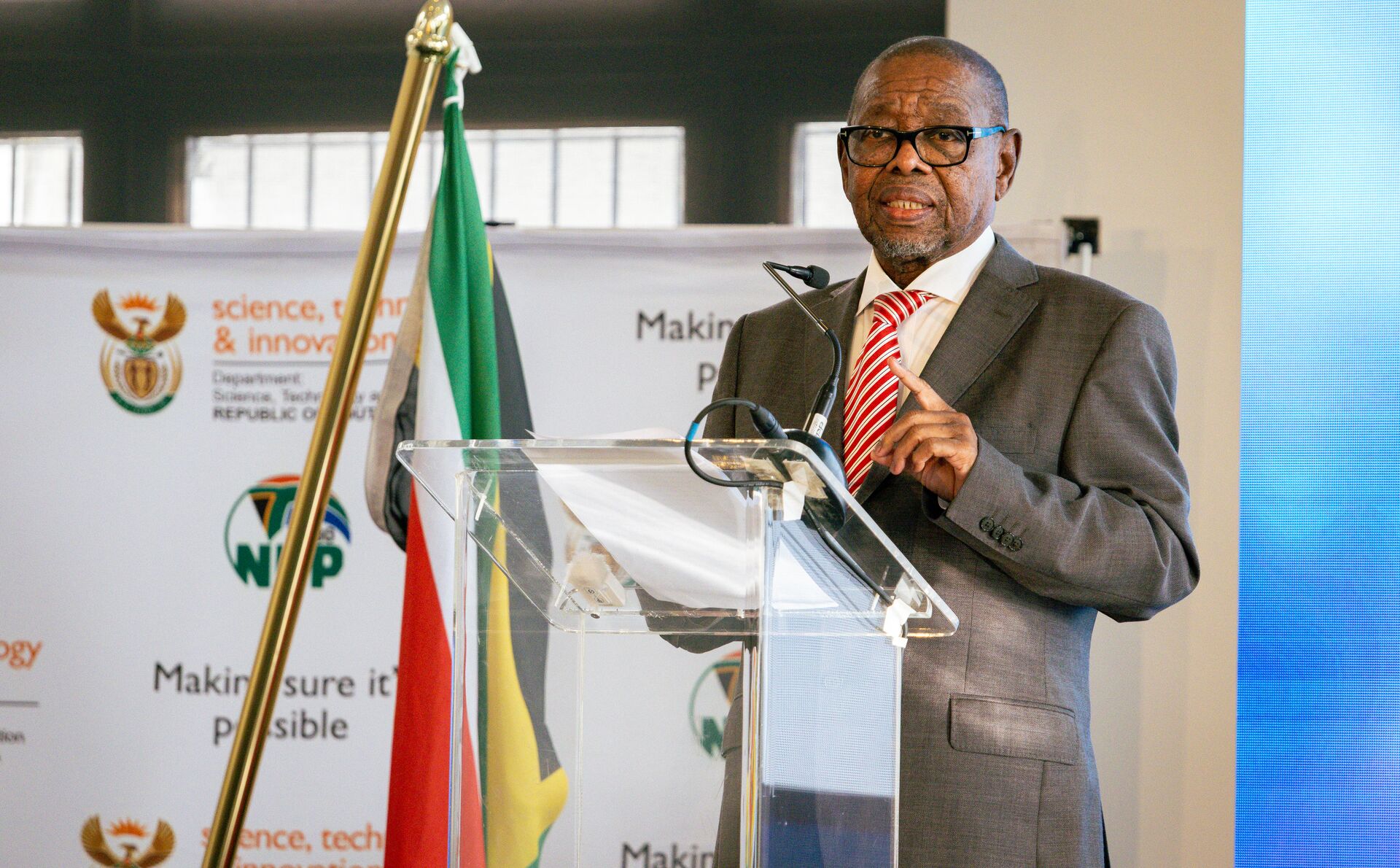
It is a great honour for me to be speaking to you on the occasion- the handover of the Naledi Primary School Media Lab.
Before I speak about the significance of this launch, I would like to remind us that, this launch take place just two days after having commemorated Freedom Day, which marked the 30th anniversary of our democracy.
As you may be aware, this year, we mark freedom under the theme “30 Years of Democracy, Partnership, and Growth,”. As we are reflecting on the strides we made over the past three decades, we should never fail to honour the sacrifices of those who fought tirelessly for our freedom.
For us in the post school education and training sector, one of the benefits our freedom has been the significant expansion of access to both basic and post education, for the children of the poor and the working class.
Coming back today’s events. Today, I had two mega infrastructure projects that I have initiated and launched, the sod turning of the Realeka Secondary School Science Lab and the launch of the Naledi Primary School Media Lab.
Our country’s National Development Plan (NDP) recognises science, technology, and innovation (STI) as fundamental pillars driving economic growth, fostering job opportunities and socio-economic transformation throughout our nation.
In line with the NDP, as the Department of Science and Innovation, we continue to illustrate our commitment to support the transformation of the demographic ownership profile of technology-based firms.
This is particularly true for SMMEs, and we do this by contributing to the advancement and promotion of locally developed intellectual property (IP) and entrepreneurship.
As government, we are aware that, in effectively tackling the socio-economic challenges of our country, and climate change related issues through science, technology and innovation, we will require collaboration, investment and innovation to transform commitments into action.
With this in mind, through the Hydrogen and Energy Chief Directorate, my Department of Science and Innovation invested more than R26million to fund various Ministerial Projects.
These include Masia Water-Energy Food Nexus project, Moloke Media Lab, Bungeni Science Lab, Mugoidwa Media Lab and the Peter Mokaba Media Lab and King Makhosonke II Science Lab which I will be launching this month.
Sod-turning for the Relaleka Secondary School
Ladies and gentlemen
As said earlier, joined by the MEC for Health, Mr Madoda Sambatha and other dignitaries, I led a sod turning ceremony for the construction of the Realeka Secondary School Science Lab.
We have allocated approximately R3.5 million for the construction of this project. This Science Lab will accommodate 42 learners and will have a front station for the teacher.
The laboratory will come with furniture, science lab equipment and required chemicals for Natural Science, Life Science and Physical Science subjects, for grades 8 to 12.
The construction of the lab including furniture, equipment and chemicals are guided by the National Curriculum CAPS documentation, provided by the Department of Education, to ensure it is sufficient to meet the national curriculum requirements and safety standards.
The media laboratory will be powered by solar photo-voltaic (PV) with an MLT inverter. MLT Inverters (Pty) Ltd (MLT) was funded by the DSI in the past to develop a control system for its inverter. Through the Media Lab project, locally developed and publicly funded intellectual (IP) will therefore be advanced and promoted.
The electricity production by the PV solar system, consumption by the science lab will be monitored remotely through a dashboard system by engineers.
Naledi Primary School Media Lab
In the delivery of the Naledi Primary School Media Lab, my Department of Science and Innovation has partnered with other institutions and organisations to deliver this project. These include:
- South African National Energy Development Institute (SANEDI).
- Stellenbosch University’s Centre for Renewable and Sustainable Energy Studies under the DSI’s Renewable Energy Hub and Spokes Programme; and
- Vuselela TVET College.
With the support of our various partners, I officially handover this media lab here at Naledi Primary School, which is a state-of-the-art containerised learning environment capable of delivering modern-day and futuristic teaching and learning services.
The money investment for the construction of this lab is also approximately R3.5million. The media lab has 40 computers powered by a solar energy system, comprising an 8.8 kWp rooftop solar photo-voltaic (PV) generator connected to a 20kWh lithium-ion battery storage.
The PV system is equipped with online energy monitoring, providing access to real time energy generation and usage data from smart phones or a web portal.
The computer equipment comprises Chromebooks that are inherently immune to software viruses. The computers also include Google Educational Suite, which enables collaborative learning opportunities on a secure platform.
Including an online resource for extending the school curriculum, complemented with a SMART whiteboard for interactive and effective teaching and learning experience.
The software will help improve collaboration, productivity, class management and foster collaboration, making it easy for everyone within the education community to collaborate, communicate, and participate in real time. In addition, the software will also enable teachers to:
- Communicate with students, other educators, guardians, and administrators from anywhere;
- Save time on teaching, testing, grading and organising;
- Give transparent and meaningful feedback; and
- Streamline their workloads.
Furthermore, the laboratory has a state-of-the art security system, combined with a secure design, to prevent incidents of theft and damage. The laboratory also meets all health and safety regulations for such facilities, including fire extinguisher units.
Through the partnerships with the Stellenbosch University, CloudEdu, Vuselela TVET College and the Department of Basic Education, the media lab will provide coding and robotics training to learners from Naledi Primary School and surrounding primary and high schools.
This creates a pipeline of future scientists, technologists, and engineers to enable and guide their teaching and learning in line with the 4th Industrial Revolution (4IR).
The media lab will also be used for the upskilling and reskilling of public officials from the Ngaka Modiri Molema District Municipality and Tswaing Local Municipality in the renewable and sustainable energy space, in support of the just energy transition.
Vuselela TVET College has also committed to supporting the school by providing 24-hour security services. This initiative is indicative of Government’s commitment to contribute to the “Pro Women and Youth” Agenda that continues to remain central to the strategic plan of the district municipality as well as the implementation of the 5-point District Economic Recovery Plan.
In particular, the massive infrastructure investment as well as skills and capacity development aspects, as outlined in the Ngaka Modiri Molema District Municipality 2023/24 Integrated Development Plan.
Government’s efforts and initiatives such as the Naledi Primary School Medial lab project, will continue to contribute to South Africa’s ability to create an enabling ecosystem that supports renewable energy-related innovation and skills development.
As we hand over this state-of-the-art lab today, I would like to plead with you to look after this infrastructure. It would hurt me deeply if I were to come back in a few years’ time to find this world class facility in a state of neglect.
These initiatives are evidence of government’s commitment to improving the socio-economic condition of people and ensuring that our young people have access to quality education and relevant skills.
I also wish to encourage the learner and young people to make sure they visit our exhibition stalls. Our SETAs, TVET Colleges, Universities and Science Councils are offering useful information that can help you make informed decisions about your future.
In conclusion, let me take this opportunity to thank Mr Babuang Pelele, who is a teacher here at Naledi Primary School. Mr Pelele took an initiative to write to my office and make a compelling case for us to decide to bring this infrastructure here at Naledi Primary School.
He did not only stop at that but, he also made a case for the establishment of the Realeka Primary School Science lab. Let me also take this opportunity to thank the North West Acting Premier, Mr Nono Maloyi welcoming us to the province, the MEC for Education and you MEC for Health, Mr Mododa Sambatha.
My gratitude also goes to the Mayors, Councillors, Chairpersons and CEOs of all our entities present, traditional, faith-based leaders and all educators and government officials present today.
Lastly, I thank all the learners who are our important guests for today.
I thank you for your attention.